Amazon Robotics models warehouse robot routing as an optimal-transport problem
Amazon Robotics has described a way to plan paths for thousands of warehouse robots by treating the problem as an optimal-transport problem, according to a post on the Amazon Science blog. The company says a Schrödinger bridge can approximate near-optimal routes at the scale of a fulfillment center. The approach is still a research result described by the company itself, and its figures are the company's own.
The post says Amazon Robotics operates over a million robots in more than 300 warehouses worldwide. Inside one site, thousands of robots move inventory for customer orders and restocking, which makes efficient, collision-free paths central to daily work, according to the post.
The routing problem
The underlying challenge is multiagent pathfinding, known as MAPF. The post describes a warehouse as a rectangular grid in which each robot, at each time step, can move north, east, west or south, or wait. All of these choices must be coordinated so that robots never collide. Over a planning horizon of T time steps, the number of binary decisions grows roughly with the product of grid size and time, which yields far more combinations than can be checked one by one.
The post says that finding optimal paths that minimize total move cost or arrival time, without collisions, is NP hard in general. In plain terms, the computing effort can become intractable even when the number of robots is only moderate. That is why the company looked for a different way to frame the problem.
Robots as a gas
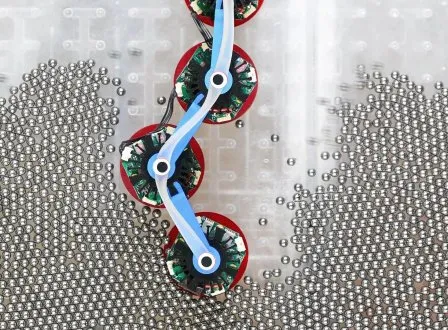
In a paper presented at the International Conference on Machine Learning (ICML), the researchers propose planning trajectories as if the robots were particles of gas. A cold, lazy gas, whose particles spend only the minimum effort needed to reach their destinations, yields optimal minimum-energy paths. The post says this is equivalent to treating trajectory planning as an optimal-transport problem. The catch, according to the post, is that computing those optimal paths may take too long for real-time deployment.
A hot gas, whose particles jitter randomly, yields paths that are quicker to compute but may fall short of the best route. The post says these paths converge on the lazy-gas ones as the temperature drops to zero. Amazon's method uses a Schrödinger bridge, a hot-gas model, to approximate the cold-gas solution, and the amount of added entropy plays the role of temperature.
From Monge to multimarginal transport
The post traces optimal transport to 1781, when Gaspard Monge, called the father of differential geometry there, looked for the cheapest way to move excavated dirt to military fortifications. Monge required each source's material to go to one destination, a hard nonlinear problem. Around 150 years later, Soviet mathematician Leonid Kantorovich let material be split among several destinations, which turned the task into a linear program. He later won the Nobel Memorial Prize in Economic Sciences for his work on optimum allocation of resources.
Standard optimal transport links only a start and an end distribution, leaving out paths and collisions. The company therefore uses multimarginal optimal transport, or MMOT, which adds distributions for intermediate times so that motion is modeled across space and time. For anonymous MAPF, where any robot can go to any destination, the post says MMOT reaches optimal solutions with a runtime of about n to the power of 1.68 in practice, with a theoretical upper bound of roughly n cubed.
Why integer paths matter
The post explains total unimodularity, a mathematical property of the constraint matrices. Its decision variables can be viewed as points in a high-dimensional shape called a polyhedron. The post says the property ensures that the corners of that shape have whole-number coordinates. A linear objective reaches its best value at a corner, so a linear program can return optimal, integer solutions in polynomial time. Without this property, the solver may return fractional answers, such as sending half of a robot along one route and half along another.
The company gives a concrete test on a 150×150 grid with 1,125 robots, which has 3.4 million decision variables over 30 time steps. Its solver, which preserves total unimodularity, reports optimal trajectories in 478 seconds. The post contrasts this with an NP-hard formulation without that property, which often could not find a single feasible solution within 12 hours.
Trading a little optimality for speed
The post traces the idea to Erwin Schrödinger, who in 1931 asked which evolution of a hot gas cloud was most likely between two observed particle distributions. Hot-gas particles diffuse randomly rather than following fixed routes. The team applied this to robots by building a probabilistic bridge between starting and ending robot states. The post describes that bridge as an entropic relaxation of the MMOT problem.
The bridge's output cannot be run directly, since it splits each robot's mass across possible destinations and robots cannot split. The post says it still reveals the main corridors where good paths concentrate. The team then drops decision variables where mass is small or travel unlikely, which restores integer paths. The company says this pipeline scales at about n to the power of 1.15. On the 1,125-robot grid, runtime fell from 478 seconds to 67 seconds, within 6.5% of the optimal trajectories.
The post says the team is developing extensions to labeled MAPF, where each robot has a fixed destination, and to lifelong MAPF, where robots handle continuous streams of tasks. It also says the link between optimal transport and multirobot coordination could combine linear and integer programming with learning-based methods such as DeepFleet and imitation learning. The post does not describe a live deployment in a warehouse, and the reported results come from the company's own work.
Source
- Lazy gas, hot gas, and a thousand robots — Amazon Science