
PILLSID: an ingestible robot that delivers insulin without external needles
Imagine a cargo rocket launching into space and docking with the International Space Station. The rocket maneuvers toward the station and locks on with a airtight latch so supplies can be transferred. Now imagine a miniaturized version of this process taking place inside your body.
In August 2021, researchers from Italy announced that they had created a robotic system capable of this kind of useful "delivery," which operates entirely inside the intestine. The system includes an insulin-delivery robot, surgically implanted in the abdominal cavity, and swallowable capsules that supply the device with insulin.
The developers tested their system on three diabetic pigs. According to results published in Science Robotics, the system successfully controlled the pigs' blood glucose levels for several hours. "It may be creepy to think of a docking station inside the body, but it worked," said Arianna Mensiassi, the paper's author and a professor of biomedical robotics and bioengineering at the Sant'Anna School of Advanced Studies in Pisa.
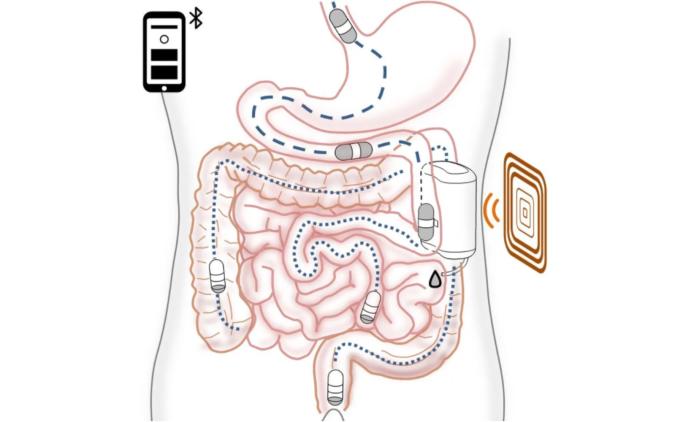
"In this study, we describe a PILLSID prototype. The key parts of the device are tested both as individual components and within the integrated device at the preclinical level. We demonstrate that the refilling mechanism works effectively and that blood glucose levels can be safely regulated in diabetic pigs. The robot weighs 165 g and measures 78x63x35 mm, which is comparable to commercial implantable devices, but also addresses urgent critical challenges related to reservoir filling and power supply," the scientific paper states.
In Mensiassi's system, a device the size of a flip phone is surgically implanted along the large wall connected to the small intestine. The robot delivers insulin into fluid in this space. When the reservoir runs low on medication, a magnetic capsule filled with insulin moves in to refill it.
In theory, the refilling procedure would work in humans as follows: the patient swallows a capsule like a regular pill, and it moves through the digestive system naturally until it reaches the section of small intestine where the implant is installed. Using magnetic fields, the implant draws the capsule toward itself, rotates it, and secures it in the correct position. The robot then punctures the capsule with an extendable needle and pumps insulin into its reservoir. The needle must also pierce a thin layer of intestinal tissue to reach the capsule.

In total, the implant contains four actuators that control docking, needle puncture, reservoir volume and aspiration, plus a pump. The motor responsible for docking rotates a magnet to lock the capsule into place. The authors say the design was inspired by industrial clamping systems and pipe-inspection robots.
After delivering insulin, the implant releases the capsule, allowing it to pass naturally through the digestive tract and leave the body. The magnetic fields controlling docking and release are managed wirelessly by an external programming device and can be turned on or off. The implant's battery is charged wirelessly using an external device.
Such a delivery system could be useful for people with type 1 diabetes, especially those who must inject insulin several times a day. Insulin pumps are commercially available, but they require external equipment that delivers the medication through a tube or a needle inserted into the body. Implantable insulin pumps also exist, but these devices must be refilled through a tube protruding from the body, which causes bacterial infections, and such systems have not become popular.
According to Mensiassi, a fully implantable system refilled by a pill would eliminate the need for protruding tubes and external equipment. The authors report that this mechanism could also be useful for delivering drugs for other diseases, particularly chemotherapy for people with ovarian, pancreatic, stomach and colon cancer.

As a next step, the authors are working on more reliable sealing of the implanted device. "We observed in some pigs that bodily fluids got inside the robot," Mensiassi said. She explained that some leaks likely occur during docking, when the needle exits the implant. No leaks occurred when the team previously tested the device in water, but the human body is much more complex.
Creating fully implantable robots that replace or restore physiological functions is a major challenge in medical robotics.
Although it will likely take some time before the Italian team's system reaches hospitals, devices that meet medical needs from inside the body may become increasingly common. For example, in 2016 MIT demonstrated an origami robot that can retrieve objects from inside the intestine.


