Air White Whale unveils W8000 cargo drone with eight-ton target
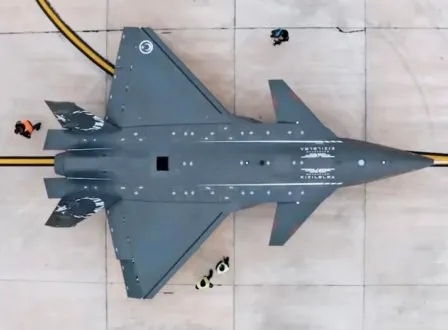
Air White Whale has revealed the W8000, an uncrewed cargo aircraft designed around a payload of up to eight metric tons. The twin-turboprop concept was shown in Zhuhai before the China International Aviation & Aerospace Exhibition, and its proposed capacity would put it among much larger transport aircraft than the company’s W5000, which is designed for five tons. The W8000 is not yet a flying aircraft: key performance and operating details remain unknown, according to TWZ.

Profile view of the W8000 at Zhuhai. Photo: TWZ
The aircraft’s scale reflects a wider ambition to move substantial freight by autonomous airlift rather than by small delivery drones. TWZ said the W8000 is part of Air White Whale’s effort to develop a family of cargo UAVs, or uncrewed aerial vehicles, for regional freight and hard-to-reach locations. The publication also identified possible military transport uses, while noting the aircraft’s future role and capabilities remain uncertain.
A larger design still on the drawing board
The eight-ton figure is a design goal, not a demonstrated carrying capacity. TWZ reported that Air White Whale has not made clear the W8000’s range, maximum takeoff weight or operational requirements. For scale, the publication compared the proposed payload with that of the DHC-5 Buffalo, a crewed, twin-engine turboprop transport aircraft built for short takeoffs and landings.

The W8000’s engines have yet to be identified. Photo: TWZ
https://twitter.com/i/status/2121656661320278350
The W8000 has a rear loading ramp, as does the W5000, allowing cargo to enter and leave from the back. TWZ said the planned payload could accommodate bulky freight such as industrial supplies, equipment and palletized goods. A payload is the cargo an aircraft carries, distinct from the aircraft’s own weight and fuel.

Rear view of the W8000 at Zhuhai. Photo: TWZ
The company’s nearer-term test program centers on the Air White Whale’s W5000, which completed its first flight on November 14, according to TWZ. The aircraft reportedly spent about 30 minutes in the air after using roughly 600 meters of runway. Its test included maneuvers and checks of autonomous flight functions, communications links, propulsion and flight controls.
Commercial routes and military possibilities
TWZ reported that the W5000 is designed for loads of up to five metric tons and has a stated maximum range of 2,600 kilometers. The publication also cited a maximum takeoff weight of 10.8 tons and cargo space exceeding 65 cubic meters. Chinese sources, as described by TWZ, have cited 835 orders or potential commitments from domestic logistics firms, but it is not clear how many are firm contracts. Commercial service has been planned for the end of 2027, subject to testing and certification.
For commercial operators, large uncrewed aircraft could be useful where rail or road links are sparse, or where frequent flights with conventional cargo planes are too costly. Removing the onboard crew would not eliminate the need for maintenance staff, ground crews, cargo facilities or an operating network, TWZ cautioned. The publication said a future ability to fly in controlled airspace and take work from crewed feeder aircraft remains a distant possibility.
TWZ also outlined possible military roles, including resupply of remote bases and island outposts. In the South China Sea, such aircraft could potentially bring equipment, medical supplies and spare parts to isolated sites; in western China, they might serve remote areas where roads are limited and air transport faces added challenges. The publication framed these as potential uses, not confirmed missions for the W8000.
In a conflict, uncrewed cargo flights could avoid exposing pilots to contested routes and might reduce the need for combat search-and-rescue support, TWZ said. The aircraft themselves would still be at risk, and their usefulness could depend on reliable communications, autonomous navigation and the ability to fly without constant satellite-navigation access. Those requirements remain part of the broader challenge of developing such transports.
Other cargo-drone programs
The W8000 is larger than several other Chinese uncrewed transport projects described by TWZ. Tengden’s four-engine TB-001D Scorpion D, which first flew in October 2022, is designed for up to 1.5 metric tons of cargo; the Star UAV System AT200 is in the same payload class. The publication also listed the state-owned Aviation Industry Corporation of China’s HH-100, with a reported capacity around 700 kilograms, and the CH-YH1000 from the China Aerospace Science and Technology Corporation, designed for about one ton.
The United States is pursuing uncrewed cargo aircraft, too, according to TWZ. Textron Aviation and autonomy specialist Merlin have presented the Cessna SkyCourier UX concept, based on the twin-engine Cessna 408 SkyCourier, with a proposed load of about 6,000 pounds and a range of roughly 900 nautical miles. Designers are considering a cockpit-free layout, a nose section that opens hydraulically for loading, kneeling landing gear and integrated cargo equipment for use at austere sites.
TWZ said the U.S. Air Force had conducted Pacific logistics trials with Cessna Caravan planes flying autonomously, with Joby Aviation and the autonomy team formerly known as Xwing involved. The publication also reported that Oshkosh Defense had teamed up with Grid Aero to develop military cargo drones drawing on the startup’s Lifter aircraft family. Grid Aero calls the Lifter a “pickup truck of the skies”; the planned aircraft is designed for loads between 1,000 and 8,000 pounds over about 1,500 miles.
A test milestone before a bigger step
TWZ argued that the United States may have a strong operational rationale for this kind of aircraft because military forces could need supplies across the long distances of the Indo-Pacific. It said supporting forces on separated islands, remote airfields and forward locations would put pressure on conventional airlift and sealift. The W8000’s reveal, however, does not establish that the design can meet such demands.
For now, the W8000 signals the payload class Air White Whale hopes to reach, while its smaller aircraft provides the more immediate test of the company’s progress. TWZ said the W5000’s flight program will help show whether the designs can become operational aircraft. If the larger model advances, it could give the company an option for heavier loads alongside the W5000, but the available information leaves its performance and timetable unsettled.