
Fast microfiber actuators successfully mimic human muscles
Robotics, prosthetics and other engineering applications typically use actuators that imitate the contraction of animal muscles. However, the speed and efficiency of natural muscle fibers remain the required benchmark. Despite new developments in actuator technology, in the past artificial muscles were either too large, too slow or too weak.
A group of engineers from the University of California, San Diego (UCSD) described a new artificial microfiber made of liquid crystal elastomer (LCE) that reproduces the breaking strength, fast response and high power density of human muscles.
"Fibers capable of axial contraction are commonly found in nature and engineering applications. Despite the widespread use of fiber actuators, it is still very difficult to fabricate fiber-optic actuators with combined actuation strain, high response speed and high specific power," says the researchers' paper.
“LCE is a soft and highly stretchable polymer. When we apply external stimuli such as light or heat, this material contracts in one direction”
Although soft LCE actuators are common and can produce excellent actuation loads of 50 to 80%, their response time is usually very slow. The simplest way to make fibers both responsive and fast is to reduce their diameter. To do this, UCSD researchers used a method called electrospinning, which involves ejecting a polymer solution through a syringe or spinneret under high voltage to produce ultrathin fibers.
Electrospinning is used to manufacture small-scale materials, producing microfibers 10 to 100 micrometers in diameter. It is known for its ability to create fibers with various morphological structures and is commonly used in various research and commercial contexts.
The microfibers made by UCSD researchers measured 40 to 50 micrometers, roughly the width of a human hair. They are much smaller than existing LCE fibers, some of which can be more than 0.3 mm thick. The researchers were not the first to use this technique to make LCE fibers, but they are the first to take this fiber further. The scientists demonstrate how to control fiber actuation and measure its characteristics.
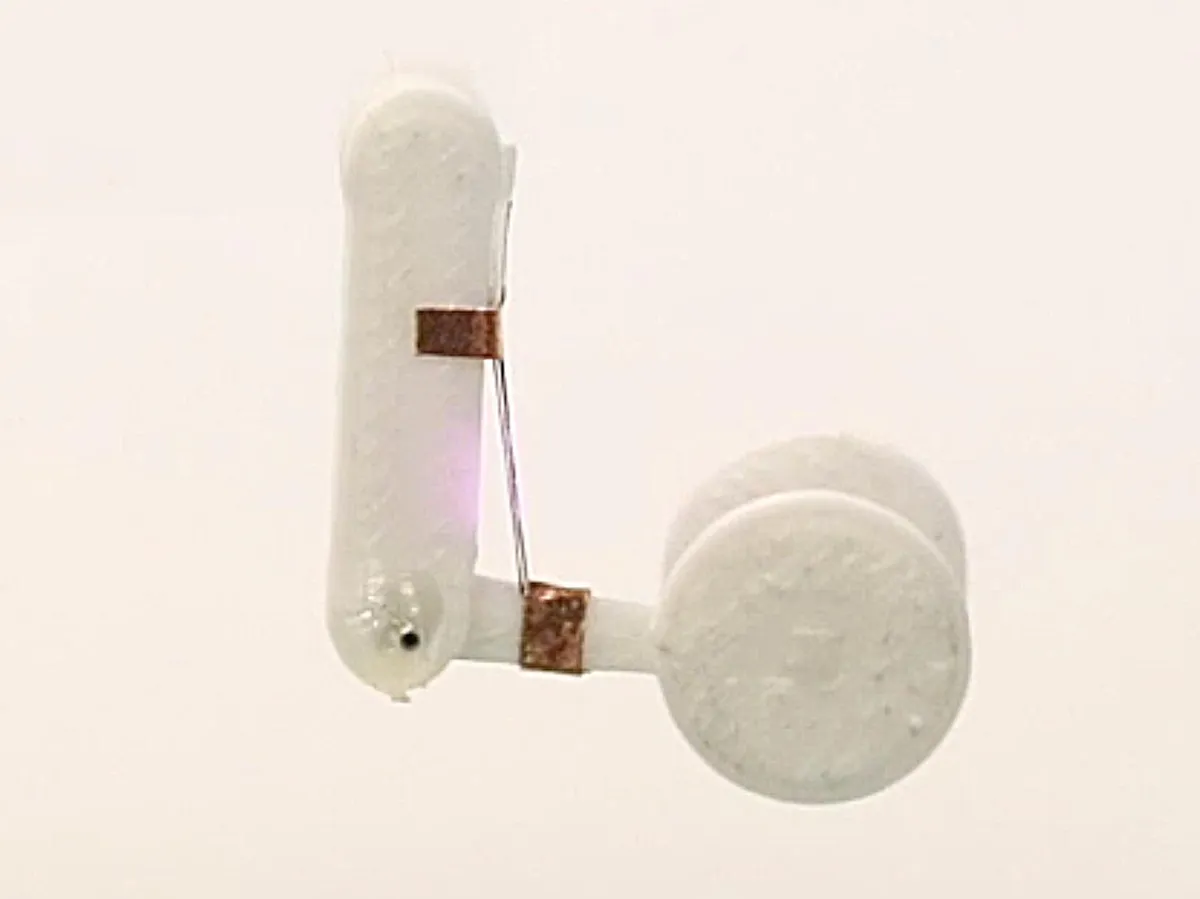
As a proof of concept, the team built three different microrobotic devices using their electrospun LCE fibers: micro tweezers, a microrobot and a light-powered microfluidic pump. Their actuators can be controlled thermoelectrically or with a near-infrared laser.
When LCE material is at room temperature, it is in the nematic phase, in which liquid crystals are randomly arranged, with all their long axes oriented essentially in one direction. When the temperature rises, the material transitions into the so-called isotropic phase, in which its properties are the same in all directions, causing the fiber to contract.
The results showed that actuation strain reaches up to 60%, meaning a 10 cm fiber contracts to 4 cm with a response speed of less than 0.2 s and a specific power of 400 W per kg. This is comparable to human muscle fibers.
The researchers note that the soft electrically controlled actuator can be easily integrated with inexpensive electronic devices, which is an advantage for microrobotic systems and devices. Electrospinning is also a very efficient manufacturing method. According to the scientists, 10,000 fibers can be produced in 15 minutes. However, a number of problems still need to be solved.
“The only limitation of this work is that when we apply heat or light to the LCE microfiber, energy efficiency is very low, less than 1%. So, in future work we may consider how to activate actuation in a more energy-efficient way”
Another limitation is that the nematic-isotropic phase transition in LCE material obtained by electrospinning occurs at a very high temperature, above 90 degrees Celsius. Thus, it is impossible to directly insert the fiber into a human body, whose temperature is 35 degrees Celsius. One way to solve this problem may be to use a different type of liquid crystal.
In their work, the scientists used RM 257 as the liquid crystal, but they could switch to another type to lower the phase transition temperature. The researchers are optimistic about the prospects for expanding research on electrospun LCE microfiber actuators.
“We have also demonstrated that we can arrange several LCE fibers in parallel and activate them simultaneously to increase output force. This is future work in which we will try to find out whether it is possible to combine their bundles into biomedical tissue”


