
Futuristic bionic arm helps amputees feel touch and movement
Dreams of a future in which arms can be replaced, as with Luke Skywalker, are more than a science fiction story. Scientists have developed a “bionic arm” that enlists the help of tiny robots to recreate the sense of life lost when an upper limb is lost. The bots do this by safely vibrating the muscles at the amputation site.
According to a report by Grand View Research for 2021, the global prosthetics and orthotics market will reach a market capitalization of more than $8 billion by 2028, but artificial limbs face a serious obstacle. They cannot convey many intuitive sensations that help us in everyday life, such as how we clench and unclench our hands into fists.
Associate professor of biomedical engineering at the Lerner College of Medicine of Cleveland Clinic and lead author of the study of the new bionic hand, published in Science Robotics, Paul Marasco said: “We are still using technology that peaked during World War II.”
Now the robotics world has discovered the bionic arm, a hybrid of metal and realistic skin tones. Although several other teams are working on bionic arms, such as the groups behind the popular cyberpunk games Deus Ex and Metal Gear Solid, Marasco touts several advantages of his version.
This science fiction device transmits information directly to and from the brain using powerful robots about the size of half a standard matchbox. By turning thoughts into actions, the arm can simultaneously contact the brain to deliver sensations corresponding to the intended action.
The new artificial limb is the first bionic arm that demonstrates its advantages over typical prosthetics in real time. For example, it reproduces the mechanics of natural arms accurately enough to restore unconscious reflexes in people with amputated limbs who use it.
We rely on such reflexes every day. For example, when we pick up a cup of coffee, our hand finds the mug on the table, grips the handle with the right amount of firmness, and releases it at the perfect time to prevent spilling. We can perform this task mindlessly even on the most hectic morning, because the nerves in our arm muscles automatically respond to our choice, in this case: “I need to drink this coffee.”

Traditional prosthetics cannot recreate such smooth movement because they operate manually. People with amputated limbs must constantly monitor them and worry about things that a healthy person usually handles through intuition.
After testing the device on two subjects and using unprecedented analytical tools, the team was excited to find that the subjects returned to the reflexive behavior they had before their amputation, including intuitive grasping and natural eye movements — they could focus their vision away from the limb.
The metal arm requires three components: rewired nerve endings, mini-robots that act as a kind of control center, and the bionic arm itself. Notably, during the surgical procedure, the unused nerve endings in the healthy part of the amputee’s arm — those previously used for distant parts such as the fingertips — are “plugged in” at the amputation site.
Marasco explains: “Your brain knows that your fingers are connected to a muscle, it just doesn’t know that this muscle is in your shoulder rather than in your forearm.” The bionic arm is placed at the amputation site, and small robots are inserted into the socket. These robots press on the relevant areas, stimulating the nerve endings that are now attached when the patient touches something with the hand.
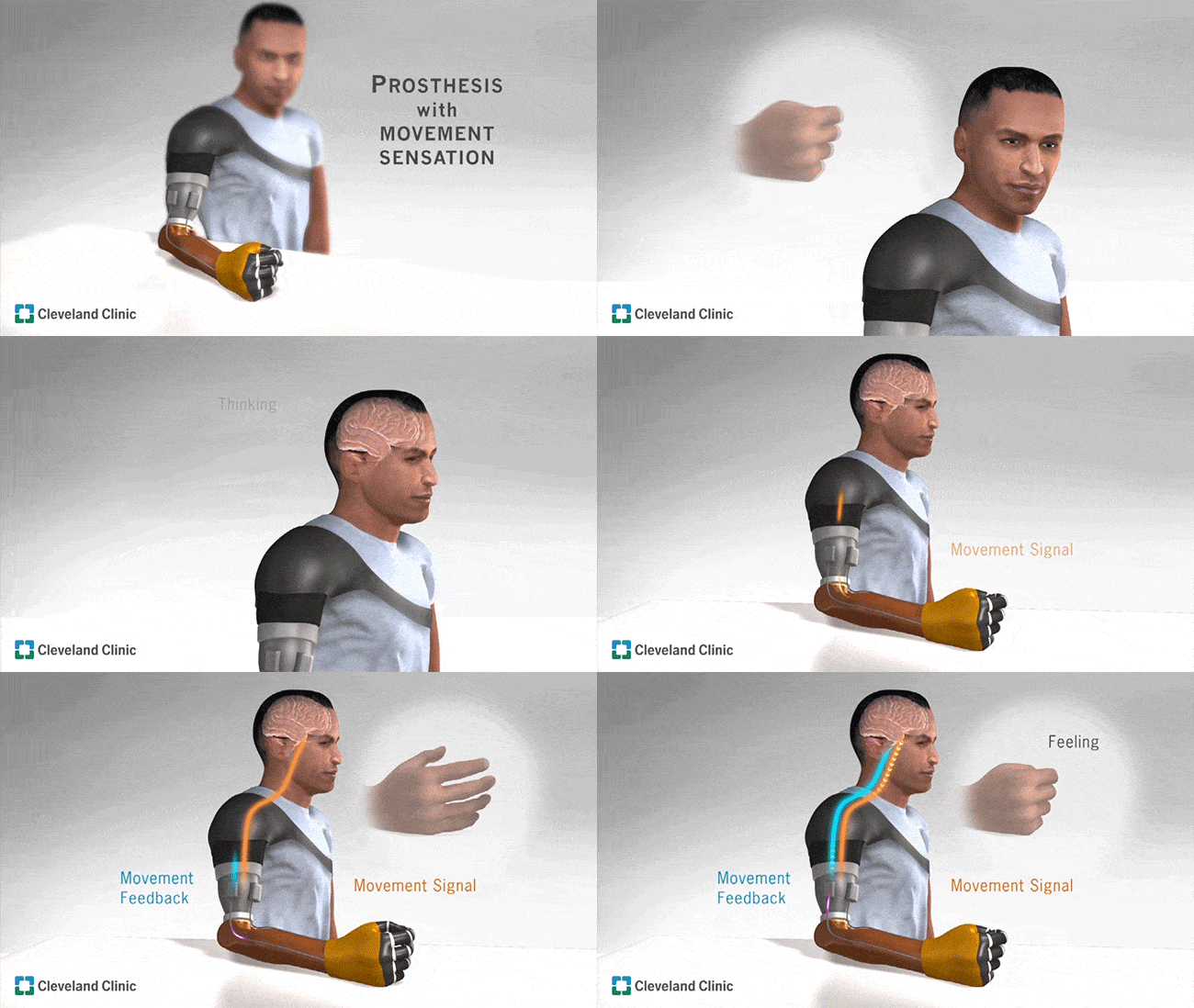
Muscles can be tensed and feel things as interesting as perceptual illusions of complex arm movement. Researchers modified existing prosthetic limbs instead of starting from scratch, hoping to quickly deliver the devices to rehabilitation clinics and make them more cost-effective than traditional prosthetics. People who use less advanced prosthetics often overuse their non-amputated side, leading to back or shoulder problems that ultimately require costly medical care.
“These advanced systems seem expensive at first, but if you use them, they won’t harm you, because you don’t need to constantly worry about them. In the future, bionic prosthetics will cost less”
The study states: “Bionic prostheses have restorative potential. However, the complex interaction between intuitive motor control and touch, which is a defining feature of human upper limb function, has not been demonstrated. Here we show that a neurobionic combination of touch, grasp kinesthesia and intuitive motor control promotes improved levels of behavioral performance that are stratified by functional capacity and differ from those of users of standard prostheses.”


