
South Korean scientists build a chameleon robot that camouflages itself in real time
A team of researchers from South Korea was so fascinated by chameleons that they built a robot with funny eyes, a waddling gait and, most importantly, skin that changes color as needed.
“It walks and changes color at the same time, so it is more or less a fully functional working chameleon”
The artificial electronic skin instantly and automatically adjusts its shades to match the colors of the background over which the robot crawls. The invention, which the scientists described in detail in a paper for Nature Communications, is one of the first devices that changes color and patterns depending on the environment. It may also help scientists create a new generation of active camouflage clothing for the military, or help designers create clothing styles that glow in different colors depending on the nearby background.
In addition to different colors, the robot can display several preprogrammed patterns on its outer surface. The skin does not fully reflect the nearby background, but even real chameleons change their shades not to reflect their surroundings but to blend into them. To copy this ability, the researchers gave the skin several patterns to choose from, each of which can be turned on and off independently. The combination of these patterned dots, stripes and swirls reflects the complexity of most backgrounds for a robot that tries to magically merge with its surroundings and disappear.
“The background does not have to be matched perfectly, since as long as it is complex enough, we can get a sufficient amount of camouflage”
To create the robot's multicolored "cloak," the researchers made the skin using a thin glaze of liquid crystal ink, which can take on any color depending on the arrangement of its molecules. When these particles gather into larger spiral structures, they can reflect light of a specific color. The size of the structures determines the displayed color. A larger repeating composition produces reddish shades. Denser arrangements appear blue.
Liquid crystals change their orientation and color depending on temperature. The researchers placed heaters under the skin of the artificial lizard. Up to ten color sensors are installed on the underside of the robot's belly, which track the shades under the device's feet. The sensors send color information back to the robot's control unit, which activates the heaters to best match the colors and markings on the floor. A device hidden inside the robot controls the heating temperature so that the colors remain stable.

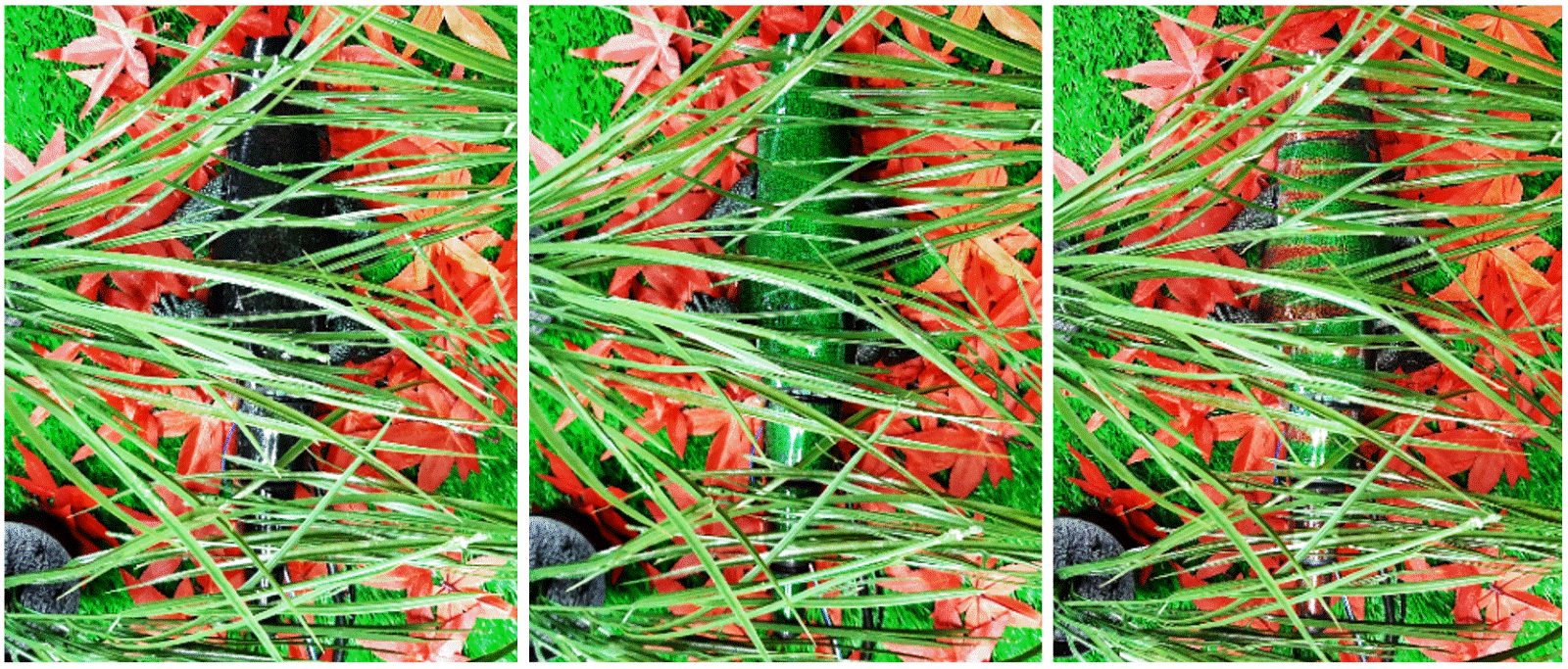
The resulting robot can match the color of its environment within half a second while moving across the floor. The researchers demonstrated that the robot can effectively hide against a background of leaves and flowers — it even copies tiger stripes by activating several heater modes at once.
Temperature-sensitive liquid crystals are not new, but the simplicity with which the researchers use them to create the chameleon effect is impressive. According to Chengi Xu, a materials engineer at Stanford, previous studies typically demonstrated color-switching technologies only in small, human-operated devices.
Instead, Hong and Ko's team fully covered their chameleon model with a cloak that changes color by itself. Xu said the researchers did a good job of integrating several technologies, such as color detection and temperature control, to create the most realistic chameleon robot: "This looks more like the future of autonomous color-changing devices."
According to Steven Morin, a chemist at the University of Nebraska-Lincoln, temperature regulation of the liquid crystal coating has several limitations. First, the skin is easier to heat than to cool, so it cannot switch from blue to red as quickly as from red to blue.
In addition, the temperature range used by the robot is fairly narrow: from room temperature of 25 degrees Celsius to about 36 degrees, like the human body. The skin color may depend on the environment, especially in cold weather or under direct sunlight on a hot day. Morin admits that reproducing color change in robots is not easy. Nature makes it look simple, but the response time and randomness of the patterns on a chameleon's skin are hard to replicate.
Aware of all these weak points, the research team is already working on several solutions. For example, adding a cooling system could expand the temperature range and speed up the robot's reflexes.
In the future, the scientists intend to create another color-changing robotic creature from the animal world: an octopus. They will borrow the artificial skin design from the chameleon to achieve camouflage for the sea creature. However, its movements are much more complex than those of a chameleon, and that is the engineering challenge.
Like Hong and Ko, Xu and Morin have also worked on color-changing materials in the past. They used different approaches to imitate what living animals still do best. Xu believes that researchers in this field still have much to learn from the physiology of actively camouflaging creatures. But it will be a difficult path.


