
NVIDIA and Lockheed Martin to Build Silicon Valley Lab to Fight Wildfires with AI
According to one estimate, intense wildfires fueled by warmer and drier weather have swept through vast areas of forest around the world, causing $20 billion in damage in the western United States alone in 2020.
To better understand wildfires and stop their spread, NVIDIA and Lockheed Martin announced that they are working with the U.S. Department of Agriculture's Forest Service and the Colorado Division of Fire Prevention and Control (DFPC) using artificial intelligence and digital twin simulation.
The companies said they are building the world's first AI-focused laboratory designed to predict and respond to wildfires. The lab will use NVIDIA AI infrastructure and the NVIDIA Omniverse platform for advanced visualization and virtual world simulation to determine the scale of a fire and predict how it will develop. By recreating the fire in a physically accurate digital twin, the system will be able to suggest actions for the best way to suppress the flames.
In 2021, wildfires in the U.S. burned more than 6.5 million acres of land, but the problem is much broader. Far more land has burned in Siberia, and truly epic fires have swept through the Mediterranean and Australia.
Lab in Silicon Valley
The new lab, based in Silicon Valley, will include the Lockheed Martin Cognitive Mission Manager (CMM) system, an integrated AI-based planning and coordination platform that combines real-time fire sensor data with vegetation, terrain, wind and other data to predict fire spread.
CMM provides incident management teams with recommendations on the order of actions to shorten response times and improve the effectiveness of wildfire suppression and humanitarian efforts. The lab will serve as an open space for industry and users to collaborate, pooling talent and resources to design CMM and rapidly prototype in NVIDIA Omniverse.
Lockheed Martin provides expertise in applied artificial intelligence, platform integration, planning and oversight, along with several dozen application engineers and data specialists. NVIDIA contributes data analytics and simulation to help with development, testing and deployment in the lab.
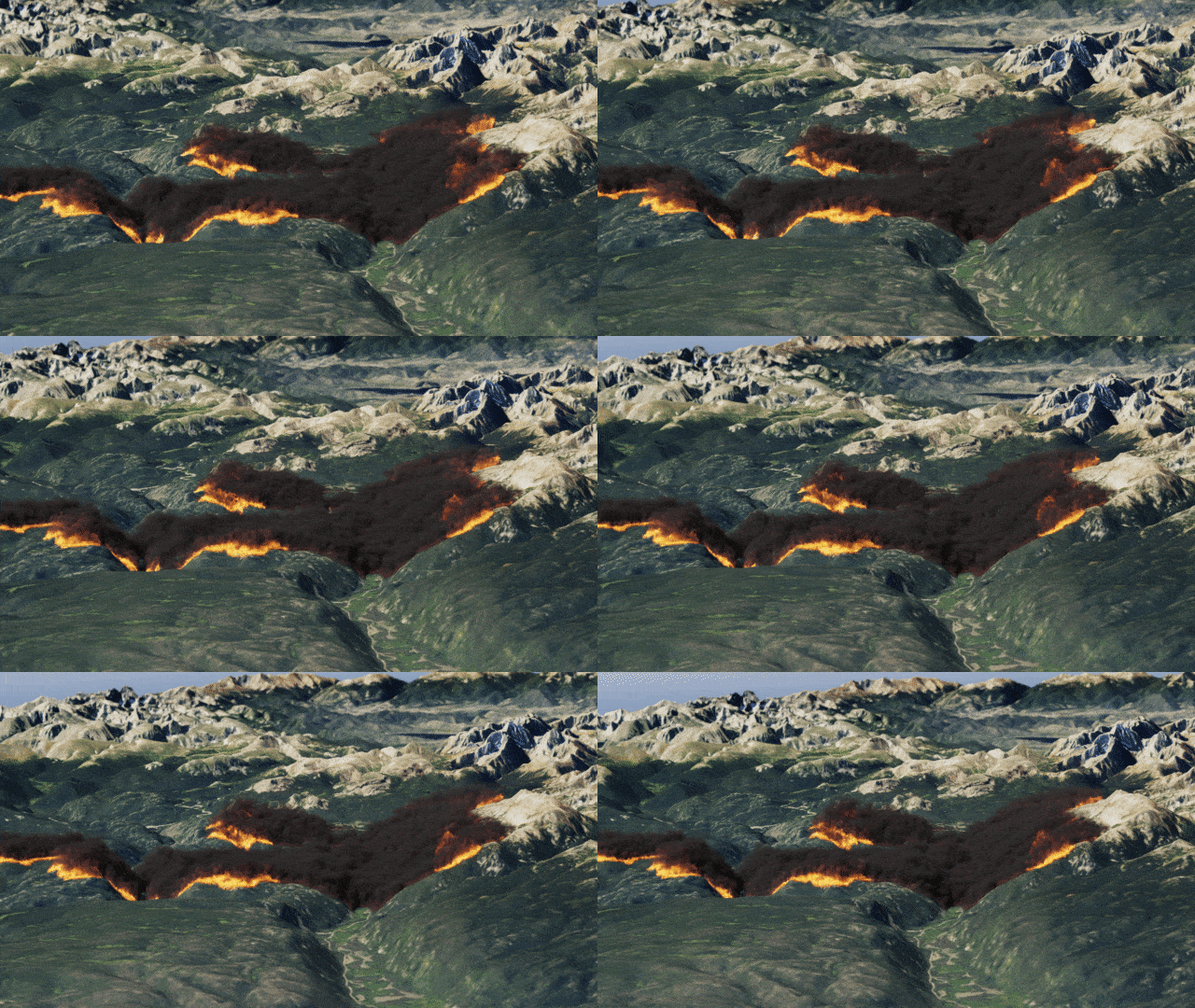
Lockheed Martin uses NVIDIA DGX systems to process data and train AI models. To visualize fires and predict how they may spread, Lockheed Martin uses NVIDIA Omniverse Enterprise.
“The combination of Lockheed Martin and NVIDIA technologies can help crews respond to wildfires faster and more effectively, while reducing risk to firefighters and residents”
Digital Twin
NVIDIA Omniverse allows fire behavior analysts to see predictions in a digital twin of the environment. Using a scalable, real-time, multi-GPU simulation platform, Lockheed Martin creates visualizations of predicted fire movement and studies the dynamics of its flows in a digital copy of the landscape. This allows the team to use NVIDIA Omniverse in many areas.
The firefighting industry relies primarily on tools derived from the Rothermel surface fire spread model (Dick Rothermel's Fire Spread Model, 1972) to predict the development of a disaster. The Lockheed Martin team is working with the group that created this model (the Missoula Fire Sciences Laboratory of the Forest Service) to study how AI can improve existing methods of predicting fire front movement with high speed and accuracy.

Using NVIDIA Omniverse, the Lockheed Martin team can accelerate the training, development and evaluation of new AI models by recreating historical fires using real data, and by showing how the Rothermel model and CMM algorithms could predict ignition. This allows engineers to simultaneously compare the development of a historical fire with the predictions of both models.
NVIDIA Omniverse also provides an immersive digital twin environment for rescue services, operators and engineers to assess the impact of their suppression actions.
“In Omniverse, you have a virtual world that is a photorealistic digital environment. In it, we can visualize fires and the factors that affect them, such as terrain, slope, wind and much more. In the near future, we will be able to generate synthetic data by moving virtual assets through Omniverse. In addition, Omniverse simulation is becoming the foundation for building additional AI-based models to study the response”
Lockheed Martin engineers working on CMM aim to integrate this technology into aircraft cockpits to display fire predictions and suggest suppression measures in real time.
Working with firefighting agencies
The U.S. Department of Agriculture's Fire Sciences Laboratory in Missoula, Montana, which conducts advanced research on wildfires, provides applications, data, software and products to help analyze and model fires.
The laboratory developed the FARSITE tool to forecast wildfire growth and behavior using the Rothermel surface fire spread model. The laboratory provided the Lockheed Martin team with critical knowledge about fire behavior and historical data.

The Colorado Division of Fire Prevention and Control (DFPC) is a partner and one of the first users of the CMM AI technologies being developed by Lockheed Martin and NVIDIA. DFPC provides expertise, user experience and feedback, as well as integration of the platform with real-time data collection.
The Lockheed Martin team is embedded in the Multi-Mission Aircraft program team to take part in operations and collect wildfire data in Colorado directly through mapping. Colorado Fire also provides historical fire data for simulation visualization in NVIDIA Omniverse. Through this ongoing partnership, Lockheed Martin engineers will be able to process data and make predictions using CMM for an active wildfire observed by aircraft in real time, to help airborne firefighting crews.
Lockheed Martin and NVIDIA will continue to collaborate, both physically and within the digital twin environment, to develop and improve CMM. One day, unmanned aircraft will quickly respond to emerging wildfires and suppress them.


