
This Climate Does Not Exist: the AI tool that visualizes climate change
Concerned by the sharp rise in natural disasters worldwide, a team of artificial intelligence researchers from Mila (Quebec Artificial Intelligence Institute) has developed a website that lets people see the potential impact of climate change on any address anywhere on the planet.
What would a place look like if it were hit by a severe flood, wildfires or smog? Using a class of machine learning algorithms called generative adversarial networks (GANs), the site This Climate Does Not Exist creates a realistic filter of climate change impacts on that place in Google Street View.
This experience raises users' awareness of possible scenarios if the world's response to climate change remains ineffective. The project is the culmination of two years of work. It mobilized more than 30 specialists and staff under the leadership of Yoshua Bengio, including the company's leading researchers Sasha Luccioni, Victor Schmidt and Alex Hernandez-Garcia. It was made possible by the financial and technological contributions of many partners.
This Climate Does Not Exist is an experience based on artificial intelligence and empathy that lets users imagine the impact of the current climate crisis on the environment. GANs are a class of machine learning frameworks that allow a computer to create and transform images.
The researchers named the project "This Climate Does Not Exist" to emphasize that climate change is causing terrible consequences around the world right now, even if you are not experiencing it in your own backyard. It also references the trend of using artificial intelligence to generate images of unreal things, such as people, cats, butterflies and even legs.
"We chose this name to illustrate that although AI-generated images reflecting the consequences of the climate crisis are not real, they serve to raise awareness and motivate action," the project's creators said. They are not climate scientists, but they did everything possible to gather reliable sources from partners such as the Climate Action Network.
Computer scientists are showing great interest in climate change and its impact on the environment. They have decided to use AI to make the world better. Climate change is a serious challenge for humanity. Preventing its catastrophic consequences will require changes in both policy and people's behavior.
However, many cognitive biases prevent people from acting, given that climate change is an abstract phenomenon that is hard to perceive as a direct threat to ourselves. This leads to psychological distancing, where the perceived distance can be related both to time (since the consequences of climate change lie in the future) and to space (since many of its effects occur far from us).
Research shows that showing people images of climate change consequences, such as flooded cities, forests destroyed by fires and cities shrouded in smog, can help reduce this psychological distance, especially if the places are familiar to the viewer.
"We believe that using AI to create images of personalized climate impacts will be especially effective in overcoming obstacles to action and raising awareness of this important issue. We hope this project will allow viewers to rethink their cognitive biases and take action, both as individuals and as members of the global community, to stop climate change," the scientists said.
Generative adversarial networks (GANs) were invented in Montreal in 2014, giving AI the ability to generate new content such as images, text and even music. At first, GANs learned to create an image of a person from a set of examples, such as images of various people. They were then improved to allow converting one group of images into another group. This process was first implemented in the CycleGAN architecture, which makes it possible to turn horses into zebras, apples into oranges, and winter landscapes into summer ones.

Generative adversarial networks, or GANs, are artificial intelligence models consisting of two neural networks: a generator and a discriminator. These networks compete with each other. The generator's goal is to fool the discriminator by creating images as realistic as possible, such as flooded streets, while the discriminator tries to distinguish images created by the generator from real images of flooded scenes. This process pushes the generator to gradually improve the quality of the images it creates and to fool the discriminator more and more often.
At the end of the training process, the images created by the generator should be indistinguishable from real images. This is called "convergence". In practice, achieving this similarity is difficult, since images have many characteristics and attributes, so the generator has to learn a very complex mathematical function to create realistic images. For this reason, it took the researchers several months to develop and train the GANs.
Specifically, their approach breaks the task of creating events into several parts. The first part focuses on learning a general "representation," which is a set of numbers that condense the information contained in images. The second part uses this information to create different events from the same representation. This provides an efficient processing pipeline, in which scientists do not need to process the input image multiple times to create visualizations of different events. Instead, they reuse this intermediate "encoding" stage of the image content.
To visualize smog, the intermediate representation is used to create a depth map that predicts the distance of each pixel from the camera, so the smog can be scaled correctly and objects further away are less sharp than closer ones.

To create an image of a wildfire, the researchers use the general representation to create a "sky mask" that predicts which pixels in the input image belong to the sky, so they can be made orange, a blur can be applied, and then the overall contrast adjusted.
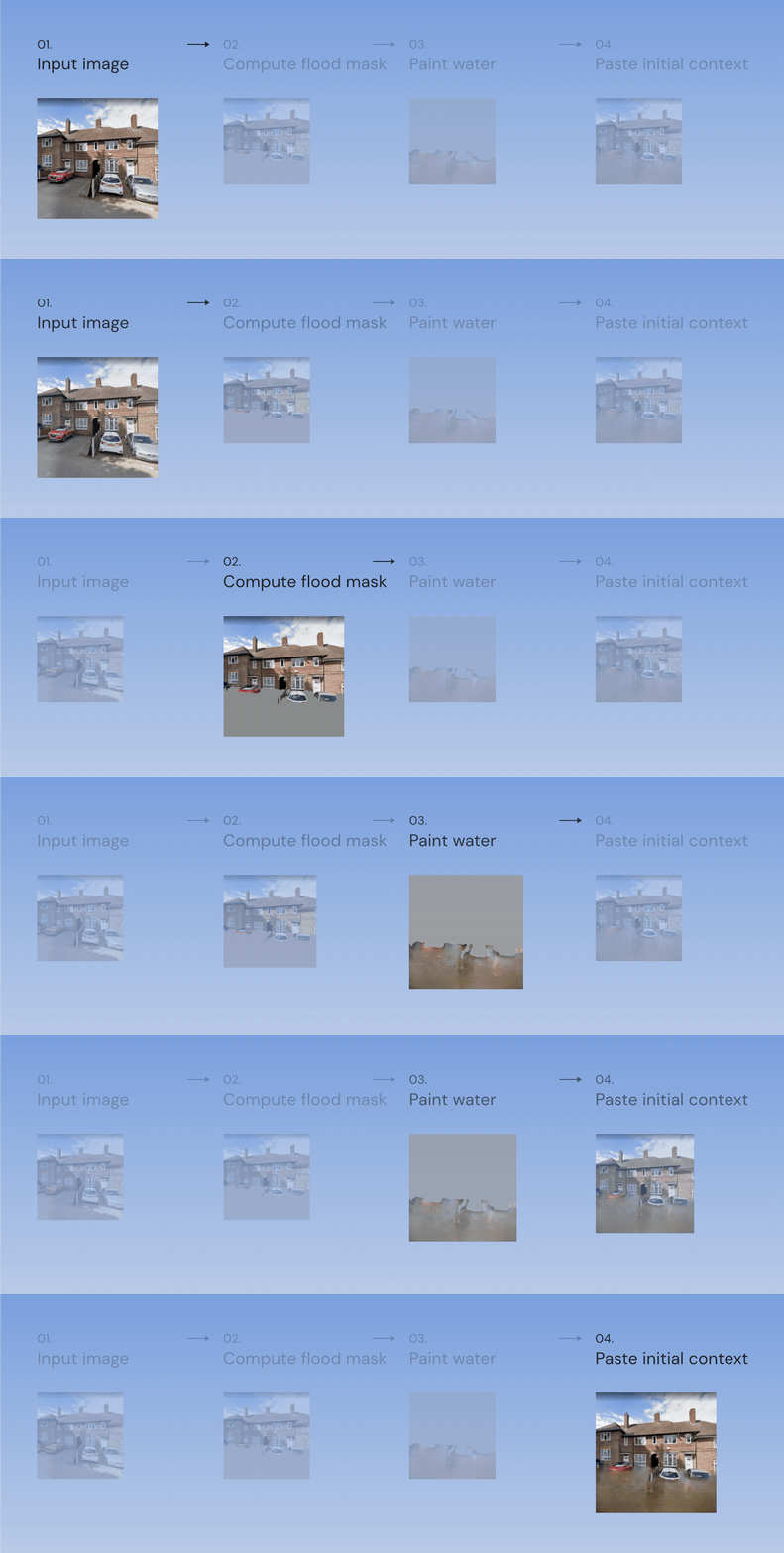
Finally, to simulate a flood, the general representation is processed to output a "flood mask" that shows where water should be added to the original scene. This mask is then used by the final piece of the puzzle, another neural network whose job is to paint water onto the input image based on the flood mask and with regard to the context of the input image.
Mila is an artificial intelligence research institute founded in 1993 by Professor Yoshua Bengio of the Université de Montréal. The institute brings together more than 500 researchers specializing in machine learning. Mila's mission is to be a global hub of scientific achievements that inspire innovation and the development of artificial intelligence for the benefit of all.
The non-profit organization has earned international recognition for its significant contributions to machine learning, especially in language modeling, machine translation, object recognition and generative models.


