
Robots and AI Help Design and Build 'Hanging Gardens'
Architecture and construction have always moved relatively slowly and quietly when it comes to technological and materials trends. That's why it's no surprise that a prestigious technical university like ETH Zurich has launched a project that uses artificial intelligence and robotics in a new approach to these crafts. The automated design and construction they are experimenting with show how homes and offices could be built in ten years.
The project is a kind of huge sculptural planter, a "hanging garden", inspired by the legendary structures of the ancient city of Babylon.
Semiramis, launched in 2019 (named after the queen of Babylon, the garden is named in her honor), is the result of collaboration between people and artificial intelligence designers. The general idea, of course, came from the creative minds of its creators, architecture professors Fabio Gramazio and Matthias Kohler. But the design was achieved by defining key requirements, such as size, watering needs and construction style, with the help of a set of computer models and machine learning algorithms.
For example, during the design process the team can adjust the position of one of the large "capsules" that make up the 22-meter structure, or change the arrangement of the panels that form its surface. The software they created would then immediately adjust the geometry of the entire structure and the other panels to accommodate these changes, ensuring it can still safely bear its own weight.
The structure consists of five complex geometric wooden blocks, slightly offset from each other and supported by eight thin steel columns. The sculpture is being designed and built using innovative digital methods developed as part of the project.
"In a typical design process for projects like this, architects try to account for the various requirements of a building or structure in their design, then adjust that design until all requirements are best satisfied. But that is not the case with Semiramis: a special machine learning algorithm, developed in collaboration with the Swiss Data Science Center, provided researchers with complex design options. The proposals varied in the shape of the capsules and their spatial arrangement relative to each other. They also highlighted how each design affects individual target variables, such as irrigation of the pods," the researchers said.

Of course, architecture already involves many automated processes, but this project pushes the boundaries at the level of the final control that seemingly rests with them. Ultimately, the goal is to make this a genuine collaboration, rather than just a kind of architectural "spell check" to make sure the structure won't collapse.
“The computer model allows us to completely change the traditional design process and explore the full range of design possibilities for the project. This leads to new, often surprising geometry”
In the Immersive Design Lab, an augmented reality laboratory on the Hönggerberg campus, scientists could explore designs in three dimensions and adjust them together in real time. Software developed jointly with the ETH Computational Robotics Lab simplifies adapting the design of the wooden modules: for example, if scientists move one point in the geometry of one of the modules, which consists of about 70 wooden panels, the software adjusts the entire geometry.
At the same time, the software takes into account relevant production parameters, such as the maximum possible weight of a panel, meaning it always creates the most efficient and load-bearing configuration. Each of the five wooden boxes of Semiramis consists of 51–88 wooden panels.
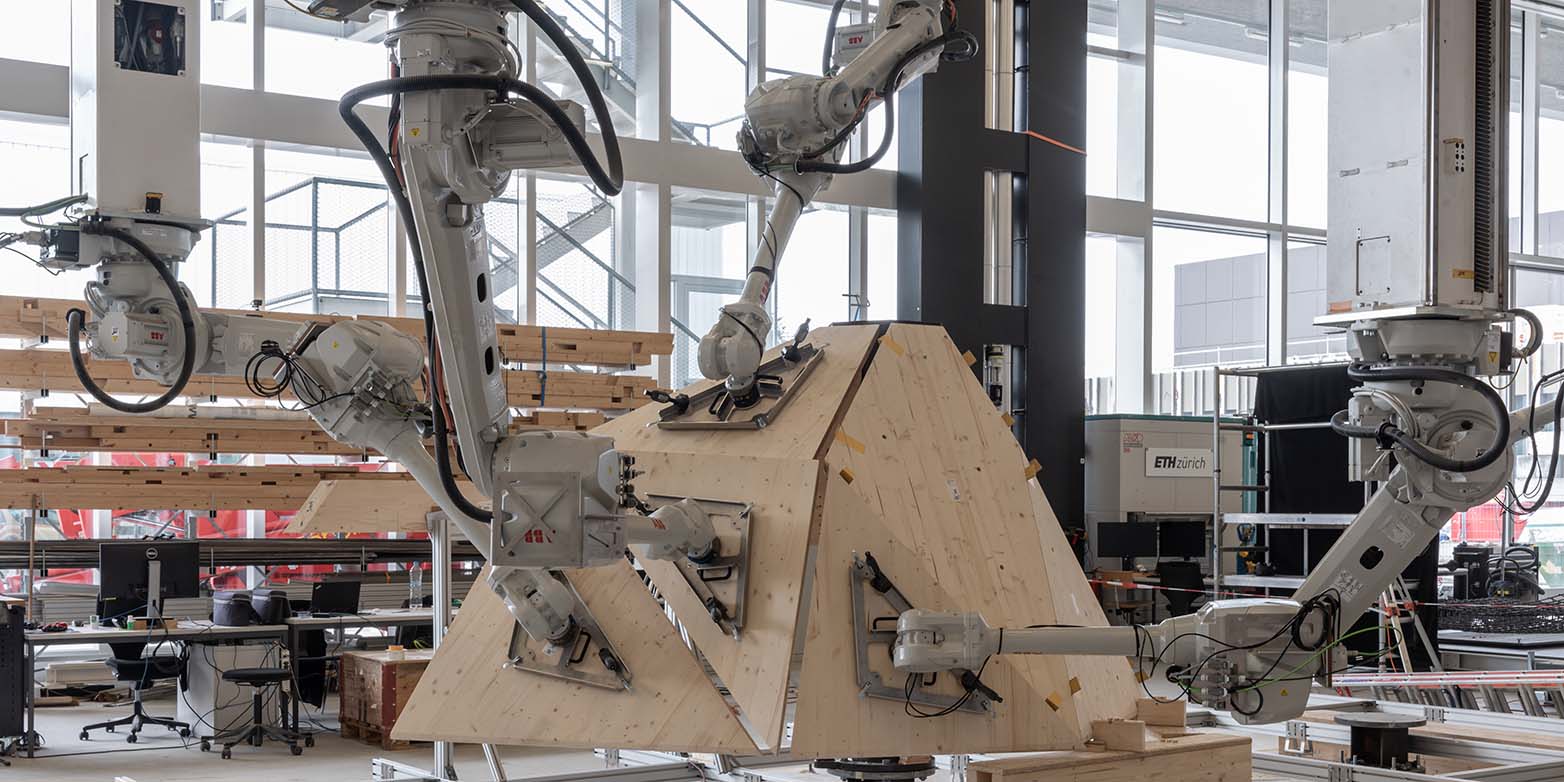
Once the final design is ready, construction is carried out by another team focused on automation: a set of four robotic arms working under a single intelligence holds several heavy parts in place (dozens in each capsule), while people apply the resin used to hold them together. The algorithm calculates the robots' movements so that no collisions occur during the task.
Unlike traditional wooden construction, robotic production has several advantages: first, robots spare people from heavy labor and precise positioning, and second, the assembly process does not require costly and resource-intensive substructures.
Robotic assembly is currently in full swing. Individual capsule segments are regularly delivered to Tech Cluster Zug by truck, where the architectural sculpture will be installed and finally planted in spring 2022. Already in summer, people will be able to see the wooden structure from the ground or from nearby buildings, and catch a glimpse of the growing plants.
Meanwhile, for Kohler the project has already proven its value: "Semiramis was a flagship project for architectural research, bringing together people inside and outside ETH and advancing key research themes of today, such as interactive architectural design and digital fabrication".


