
Researchers Find Way to Use Drones to Autonomously Scare Off Pigeons
Feral pigeons are responsible for more than $1 billion in economic damage in the US every year. They are especially irritating to residents because this bird species is not native to the country. They were brought over from Europe, but many birds escaped.
Besides spreading diseases (some of which can occasionally infect people), pigeons are prolific and clutter cities by leaving their droppings in places that are extremely hard to clean. Rooftops, as well as ledges and overhangs on building facades, are full of cozy nooks, and despite some crude attempts to solve the problem by installing metal or plastic spikes on every horizontal surface, there are usually more surfaces (and pigeons) than there are spikes.
Researchers at EPFL in Switzerland believe that defeating an aerial opponent requires an aerial approach, so they deployed an autonomous system that can identify pigeons that have invaded a roof and then send a drone to chase them away.
Drones, it turns out, are already used to deal with birds, but so far (for various reasons) they are controlled by an active human pilot who uses the drone to scare flocks away from specific places at specific times.
One reason is that flying drones autonomously is illegal pretty much anywhere, and Switzerland is no exception, so this study involved a human observer on standby, ready to take over if the otherwise fully autonomous system fails in any way.
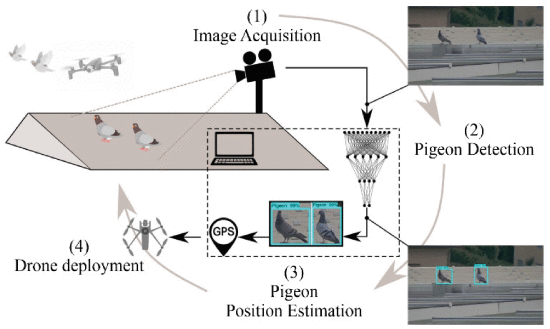
At first glance, the ideal drone-based bird deterrent system might seem to be fully autonomous: a patrolling drone uses a camera to detect wayward birds and then chases them off. But, as the researchers note, such a system is not very practical. Roofs can be large, pigeons are small, and drone cameras are even smaller. Besides, the drone would spend most of its time finding no birds and would need to be recharged often.
A better solution is a base station with a special high-resolution camera capable of pan, tilt and zoom, which can survey as much of the roof as possible without moving. When pigeons are spotted, the drone flies to the spot, spending a minimal amount of time in the air. Note that only one (monocular) camera is used here, but fortunately pigeons are mostly the same size, so distance can be estimated fairly accurately based on the apparent height of the bird.
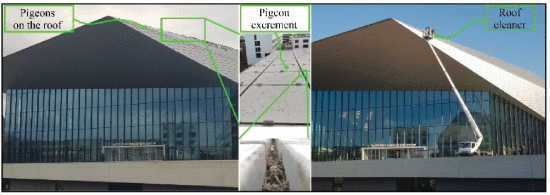
Testing on the roof of the SwissTech Convention Center in Lausanne revealed some problems with the autonomous pigeon detection system, mainly because in a flock you get a whole group of pigeons that block each other, so if your detector tries to decide whether to chase the flock based on the number of detections of individual pigeons, you can run into some issues.
Even so, the system was overall quite successful: on average, a flock of pigeons could stay for up to 2.5 hours, just resting on the roof and leaving behind a whole pile of droppings. However, when the drone was in the air, the maximum time birds stayed there was reduced to a few minutes, including the few minutes it took to detect them and actually launch the drone.
The researchers also noticed some interesting features of the behavior of the drone and the birds: "Several interesting observations regarding the interaction of pigeons and the drone were made during the experiments. First, the distance at which pigeons perceive the drone as a threat varies greatly and may be related to the number of pigeons. While larger flocks were often frightened just by takeoff (which happened at a distance of 40–60 m from the pigeons), smaller groups of birds often let the drone come within a few meters. In addition, the duration of the drone's stay in the target area is an important tuning parameter. Some pigeons tried to return almost immediately but were pushed back by the hovering drone."
The researchers suggest that a useful next step could be collaborating with zoologists, since it is possible that "the effectiveness of the system could be radically changed by using knowledge of pigeon behavior and interactions." Another interesting addition to this work could be a systematic evaluation of the system's performance in degraded visual conditions (for example, fog, rain, hail, snow).
Urbanization dramatically changes the environment and animal behavior, causing long-term consequences for them that are yet to be fully understood. Among them is the fact that pigeons have mostly adapted to life in urban areas. However, a qualitative analysis of their behavior has not been fully carried out.
"Field experiments were conducted in real urban conditions to evaluate the proposed system by comparing the number of birds and their duration of stay over more than five days with a 21-day trial experiment without a drone. Over the five days of experiments, the drone was launched automatically 55 times and was significantly effective in reducing the number of birds and their duration of stay, without causing them any harm. In conclusion, the study proved the effectiveness of this system in scaring off birds, and this approach can be considered a fully autonomous alternative to existing methods," the study says.


