
How Robots Became Essential Workers During the COVID-19 Pandemic
When the coronavirus emergency grew into a full-scale pandemic in early 2020, forcing many businesses to close, robot manufacturers found themselves in an unusual position: many saw a sharp rise in orders. Robots don't need masks, they are easy to disinfect, and of course, they don't get sick.
Since then, robots have been deployed around the world to help with the crisis: they monitor patients, disinfect hospitals, make deliveries and help frontline medical workers reduce the risk of infection. Not all robots work autonomously. Many require direct human control, and most are limited to simple repetitive tasks.
However, manufacturers say the experience robots gain will make their future machines smarter and more capable. Let's look at several real-world examples of robots being used during the pandemic.
First Line of Defense
A squad of robots serves as the first line of defense against person-to-person transmission of the coronavirus at a medical center in Kigali (Rwanda). Patients entering the facility have their body temperature checked by devices equipped with thermal imaging cameras on their heads.
Robots from the Chinese company UBTech Robotics also use their distinctive appearance to attract people's attention and remind them to wash their hands and wear masks. They resemble characters from the movie "Star Wars."

Testing
To speed up coronavirus testing, a group of doctors and engineers from the University of Southern Denmark and Lifeline Robotics developed a fully automated swab-collection robot. It uses computer vision and machine learning to identify the ideal target spot inside a person's throat.
A robotic arm with a long swab then reaches in to collect a sample. All of this is done with a speed and consistency that humans cannot match.

Ultraviolet
After six doctors were infected with the coronavirus, the Sassarese hospital in Sardinia (Italy) tightened safety measures and introduced robots. Machines developed by UVD Robots use LIDAR for autonomous navigation.
Each bot carries an array of powerful short-wave ultraviolet lights that destroy the genetic material of viruses and other pathogens after several minutes of exposure.
Demand for UV disinfection robots is surging, as hospitals around the world use them to sterilize intensive care units and operating rooms.

Repetitive Duties
In medical facilities, the ideal role for robots is to take on repetitive duties so nurses and doctors can spend their time on more important tasks. At the Third People's Hospital of Shenzhen (China), a robot named Aimbot travels through the corridors, reminding people about mask-wearing and social distancing rules, and sprays disinfectant.

At a hospital near Austin (Texas), a humanoid robot from Diligent Robotics brings supplies and delivers them to patient rooms. It tirelessly repeats this task day and night, allowing hospital staff to spend more time with patients.

Avatars
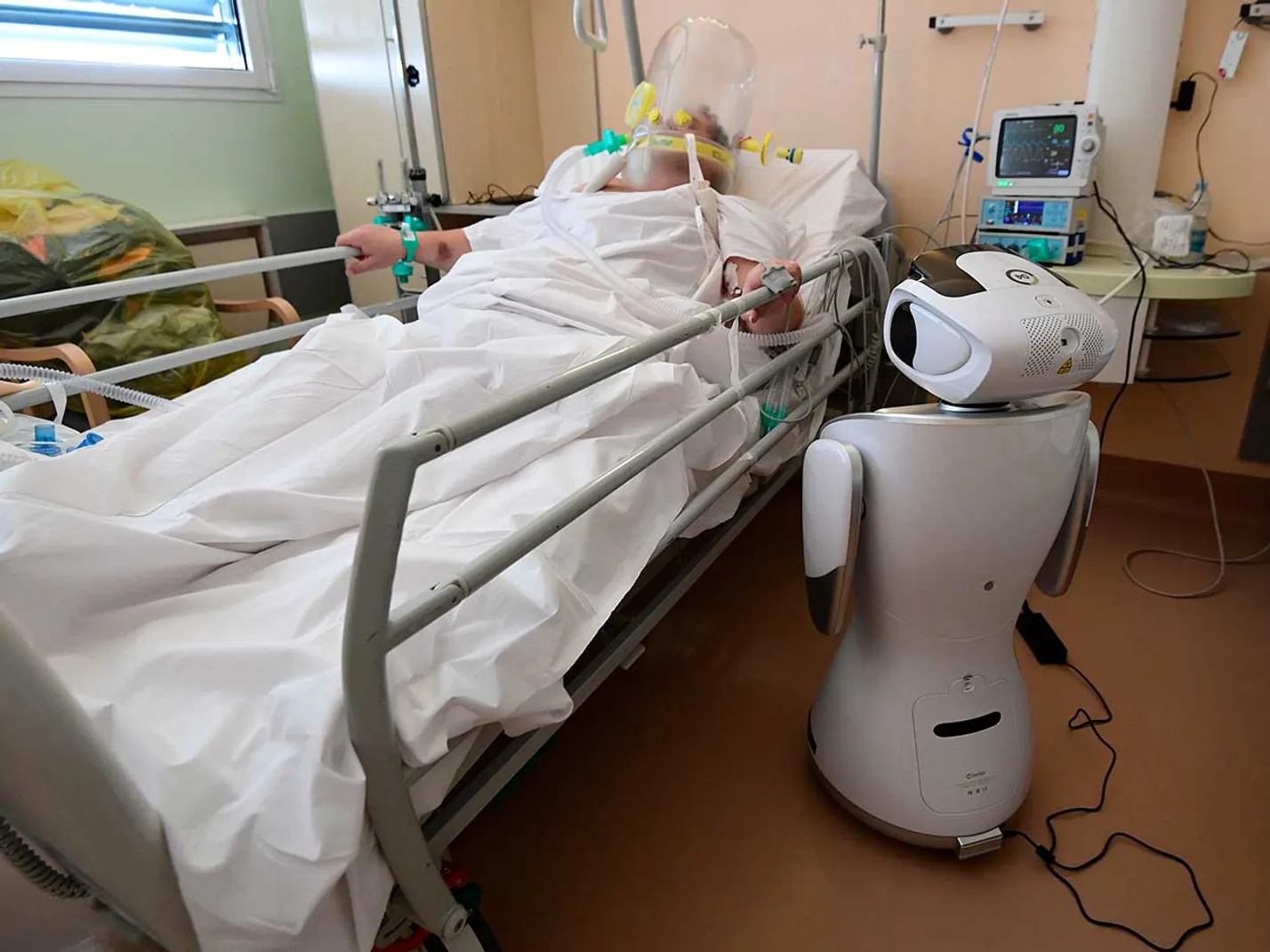
Nurses and doctors at the Circolo hospital in Varese, in northern Italy (the country's hardest-hit region), use robots as their avatars, allowing them to check on their patients around the clock while minimizing exposure and reducing the use of protective equipment.
Robots from the Chinese company Sanbot are equipped with cameras and microphones and can also access patient data, such as blood oxygen levels. Telepresence robots, originally designed for offices, are becoming an invaluable tool for medical workers treating infectious diseases such as coronavirus, reducing the risk of exposure to the pathogen they are fighting.
Help From Above
Authorities in several countries have tried to use drones to enforce isolation and social distancing rules, but the effectiveness of such measures remains unclear. Using drones for delivery is a better option. In the US, the startup Zipline deployed its autonomous aircraft to connect two medical facilities 17 km apart.
For staff at the Huntersville Medical Center in North Carolina, masks, gowns and gloves literally fell from the sky. The company says that in the future, drones will be able to deliver other types of important materials, transport test samples and distribute vaccines.

Couriers
The streets and sidewalks of dozens of cities around the world have witnessed a rapid rise in the number of wheeled robots. Delivery robots remain in high demand as online orders continue to grow rapidly.
In Hamburg (Germany), six-wheeled robots from Starship Technologies navigate using cameras, GPS and radar to deliver groceries to customers.
In Medellín (Colombia), the startup Rappi deployed a whole fleet of robots built by Kiwibot to deliver takeout food to people who are self-isolating.

China's JD.com, one of the country's largest e-commerce companies, uses robots to transport goods. Each robot has 22 separate compartments that customers open using facial recognition.


