
Facebook Robot Speeds Up and Improves Fiber Optic Deployment
As the internet becomes increasingly common in our lives and work, the technologies people use to access the network are falling further behind. Even though data consumption per person grows by 20-30% every year, nearly half the world remains left behind, either without adequate internet access or completely unconnected.
Overcoming this challenge and bringing more people to faster, more reliable internet requires new technological breakthroughs. Facebook Connectivity works with partners to develop these technologies and deliver them to people around the world. Since 2013, Facebook Connectivity has helped more than 300 million people worldwide get faster internet access.
At the Inside the Lab event in October 2021, Facebook engineers shared their latest developments in connectivity technologies aimed at improving internet bandwidth worldwide across sea, land and air. Undersea cables connect continents and form the backbone of the global internet.

Facebook's first-ever transatlantic undersea cable system will connect Europe with the United States. This new cable provides 200 times more internet bandwidth than transatlantic cables from the 2000s. The investment builds on other recent undersea expansions, including 2Africa PEARLS, which will become the longest undersea cable system in the world, connecting Africa, Europe and Asia.
To reduce the time and cost needed to deploy faster internet in various locations, Facebook developed a robot called Bombyx, which travels along power lines, wrapping them with fiber optic cable. Since its first unveiling, Bombyx has become lighter, faster and more maneuverable, and it could radically affect the economics of fiber deployment worldwide.
Facebook also developed Terragraph, a wireless technology that delivers internet access at fiber-like speeds over the air. This technology has already brought high-speed internet to more than 6,500 homes in Anchorage, Alaska, and deployment has begun in Perth, Australia, one of the most isolated capital cities in the world.

Bombyx combines innovations in robotics and fiber optic cable design to significantly reduce the cost of fiber deployment by using existing electrical infrastructure. Although enormous improvements have been made in the strength and size of fiber strands, as well as in the amount of data a strand can carry, there has not yet been a widely applicable solution for reducing the cost of fiber design.
Facebook selected ULC Robotics based on its innovative conceptual design and more than a decade of experience designing robots for high-reliability utility applications. The finished ULC design includes a pair of drive subsystems, a lift subsystem and a rotation subsystem. The robot's drive subsystem consists of several drive grippers that can move relative to each other to adapt to obstacles and conductor angles.
To get over an obstacle, the lift subsystem raises the payload and rotation subsystems from their normal cable-wrapping position, whose center of mass is aligned with the power line, until the obstacle is cleared. During this operation, the robot is placed in an unbalanced state (like a tightrope walker) and uses a stabilizer to balance itself while crossing the obstacle, after which the payload and rotation subsystems are lowered and wrapping continues.
The robot also includes a machine vision system that identifies obstacles and adjusts its movements accordingly to get past difficult sections, while maintaining the clearances needed to prevent electric shock. The robot's shape and material properties are optimized for weight and safe operation on live (energized) lines.
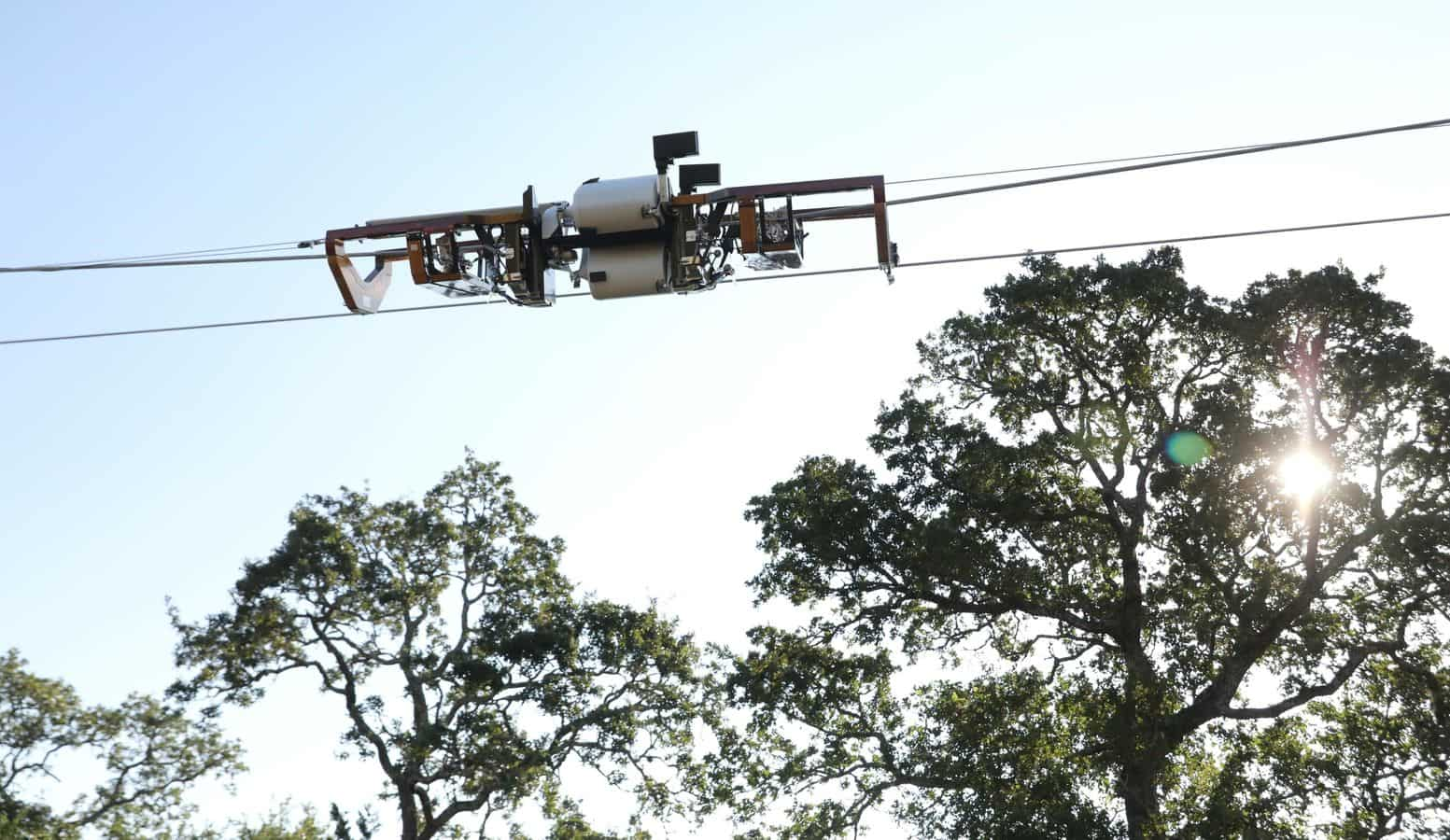
Each robot will be able to install more than 1 km of fiber and autonomously clear dozens of obstacles in about an hour and a half. To account for human-involved steps such as setting up, loading and unloading the robot, installing transitions and other tasks, Facebook conservatively estimates total assembly speed at an average of 1.5 km to 2 km per robot per day.
Many robots already exist that can autonomously move along power lines. They are mainly designed to monitor line conditions, including insulators and other elements that require periodic inspection. Some of these bots, in addition to inspecting and photographing suspicious areas, can clean contaminants from wires or perform preventive actions such as applying anti-icing compounds.
In addition, tests have been conducted on using flying drones to monitor power lines. Drones can easily identify sections of lines that need repair. The advantage is that drones do not require even a brief shutdown of the lines. Thus, automation of power line work is progressing in several different directions.


