
MIT developed a helper robot that can safely touch a human
Robotics was once considered the most difficult area of machine learning. Even simple tasks, such as moving a manipulator a short distance, were an incredibly complex engineering challenge. Can you imagine what a feat it was to apply machine learning so that a robotic arm could help a person put on a jacket?
Researchers at the Massachusetts Institute of Technology (MIT) published details of a study in summer 2021 in which they demonstrated a robotic arm helping a person, and also explained why the procedure is, they claim, safe for people.
In the demonstration, the robotic arm holds a vest in its hand, while the person's right arm passes through the opening, which is then slowly pulled up toward the shoulder. The researchers described their work in detail in a paper titled "Provably Safe and Efficient Motion Planning under Uncertainty for Human-Robot Interaction."
The research by MIT PhD student Shen Li and his team is based on an algorithmic approach built on reinforcement learning, a form of machine learning, developed in 2019 by Torsten Koller and his colleagues at the University of Freiburg in Germany.
The robot's motion problem can be summarized in some sense as a conflict between goals: one goal that is immediate and one that is long-term. The immediate goal is to avoid a situation that is dangerous for the human. The robot must be careful at every moment to avoid collisions with the human or to minimize any harmful consequences of such collisions.
Over longer time frames, the robot always has a task. It must accomplish some task, in this case helping a person get dressed. Balancing these two goals is the challenge the MIT group set for itself.
In Koller's 2019 work, scientists developed a so-called learning-based model predictive control (LBMPC) algorithm, in which the goal is for the robot to avoid collisions with the human while simultaneously finding a more efficient path to the task.
Building on what Koller and his colleagues did, Li and his team asked themselves whether it was possible, instead of completely avoiding collisions, to make the robotic arm move to where a collision with a human could be a light touch rather than a harmful blow. By allowing a so-called safe impact, the robotic arm could act without excessive caution.
According to the authors, this is an engineering system in which, instead of avoiding any contact, the robotic arm balances its target task with safety.
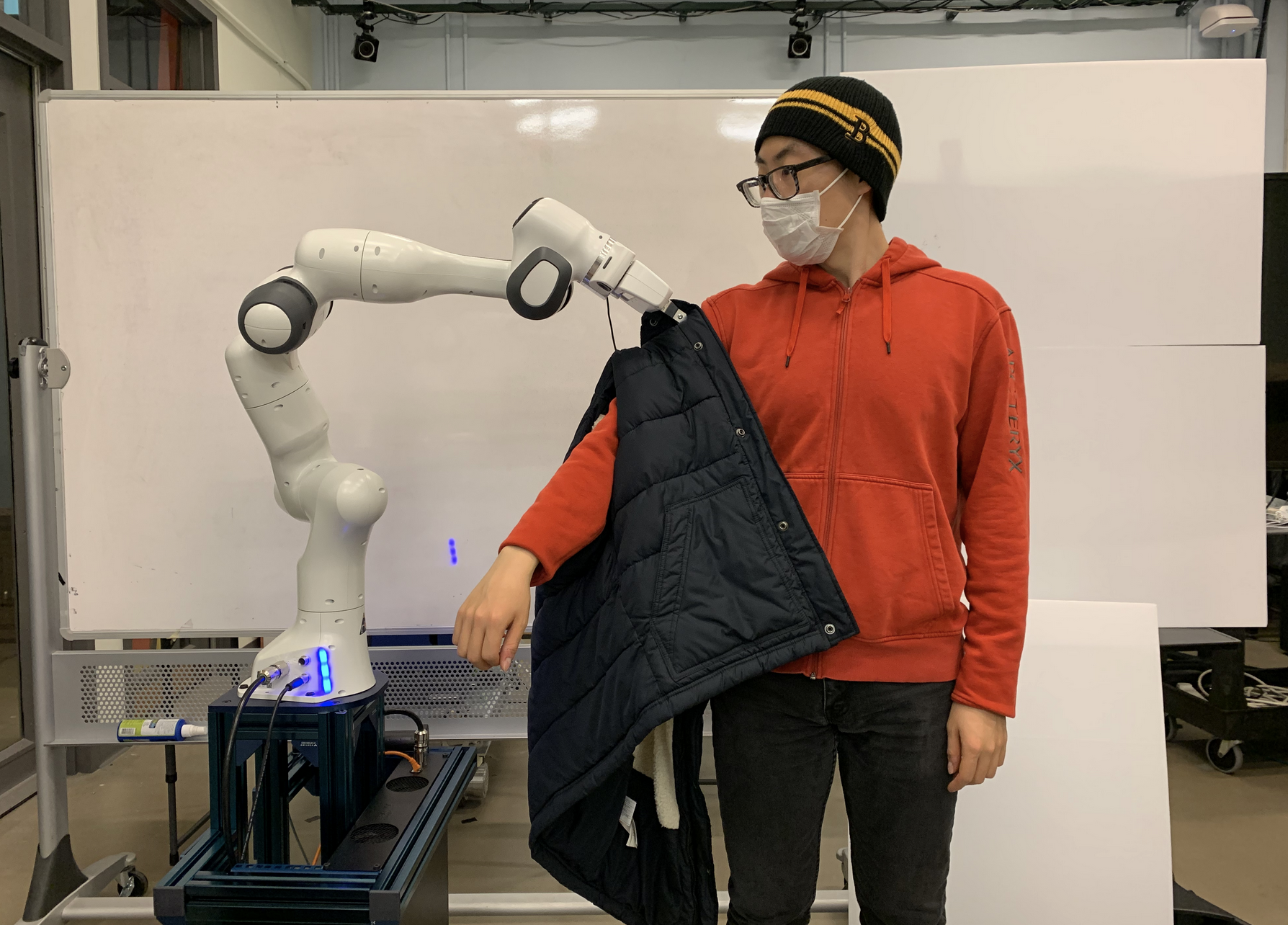
The researchers said: "To reduce the conservativeness of the system while maintaining safety, we propose a safe planner that jointly integrates predictive and reactive approaches within a framework. Our goal is to acquaint motion planners with low-level compliant controllers and to use the fact that a small impact may not be harmful to a human, which allows planners to potentially produce more efficient movements without compromising safety."
They took LBMPC and added modeling of the human's and robot's position and speed to calculate how they would impact each other in a collision. The authors did not come up with this on their own, but borrowed information from various works about which types of friction and what speed would be safe when two bodies collide.
In particular, in 2003 two researchers from the Australian National University developed an impact model to determine what is safe. In their view, such safety solutions limit the potential force of a robot's impact in the event of a collision with a human.
With a definition of what is safe, Li and other scientists can revise LBMPC so that it does not always plan only to avoid collisions, but also chooses movements even where they may lead to safe impacts.
“As far as we know, this is the first work that provides a probabilistic safety guarantee for models of human dynamics with uncertainty for human-robot systems”
The algorithm being developed, a modified LBMPC, is a probabilistic model of what may happen between a human and a machine. This is not certainty, but a prediction that in the interactions calculated by the algorithm, some outcomes will "hold with high probability."

Thus, what is provably safe is the measure of uncertainty with which a robot can move relative to a human. The range of acceptable uncertainty was slightly expanded by allowing some harmless collisions. It is important to remember that the acceptable uncertainty lies within the narrow confines of a controlled experiment, in which a number of assumptions are made.
The study's authors reported: "Our implementation relies on the following assumptions, which we made to get around problems in geometry and computer vision: the position of the human shoulder is known and fixed, and during this task the human elbow never bends. With these assumptions, we only need to track the position of the human's hand and can interpolate the arm as a line segment between the hand and shoulder positions. We also assume that the human arm remains fully observable throughout the operation, and we use the PhaseSpace motion capture system to track this."
Their work makes one more important assumption: "We assume that the human will not move while the robot is planning." All these caveats suggest that more modeling will be needed of what happens when the human is more dynamic, so to speak, with fewer constraints on the interaction.
Li's main idea is that by making their system supposedly safe, they make it easier for people to accept the system. The authors write: "Interestingly, our test subject indicated that she felt more comfortable when the robot ran our algorithm than when it simply avoided collisions."
One explanation is that the researchers' algorithm optimizes speed and safe impact when a strict collision avoidance is impossible. A safe formulation of impact could potentially improve the psychological side of human-robot interaction, in addition to providing safety guarantees.


