
MIT researchers develop AI system that helps robots manipulate objects
At just one year old, a child is already more dexterous than a robot. Of course, machines can do much more than simply pick up and put down objects, but we have not yet reached the point of replicating the natural drive to explore or sophisticated dexterous manipulation.
OpenAI tried to accomplish this with "Dactyl" (meaning "finger" from the Greek word daktylos), using its humanoid robot hand to solve a Rubik's Cube with software. This is a step toward more general artificial intelligence and a first step away from the usual single-task mindset. DeepMind created "RGB-Stacking," a vision-based system that teaches a robot to grasp objects and stack them.
Scientists from the Massachusetts Institute of Technology (MIT) Computer Science and Artificial Intelligence Laboratory (CSAIL), constantly striving to make machines reproduce human abilities, created a larger framework: a system that can reorient more than 2,000 different objects using a robot hand. This ability to manipulate anything (from a cup to a tuna can and a Cheez-It box) can help the hand quickly pick up and place objects in a specific way and in a specific location (even spinning them in the hand at different angles).
Such skillful "handiwork," which is usually limited to individual tasks and upright positions, could be an advantage for speeding up logistics and manufacturing, helping with general requirements such as packing items into fulfillment slots or deftly manipulating a wider range of tools. The team used a simulated anthropomorphic hand with 24 degrees of freedom and demonstrated evidence that the system could be transferred to a real robotic system in the future.
“In industry, parallel-jaw grippers are most commonly used, partly due to ease of control, but they are physically incapable of working with many tools we see in everyday life. Even using pliers is difficult, because the gripper simply cannot skillfully move one tool handle back and forth. Our system will allow a multi-fingered hand to skillfully manipulate such tools, which will open a new field of robotics applications”
This type of in-hand object reorientation has been a challenging problem in robotics due to the large number of motors that need to be controlled and the frequent changes in contact state between fingers and objects. The MIT system learned a lot from testing 2,000 objects. The problem becomes even more complex when the hand faces downward. The robot must not only manipulate the object but also "counteract" gravity so that it does not fall.
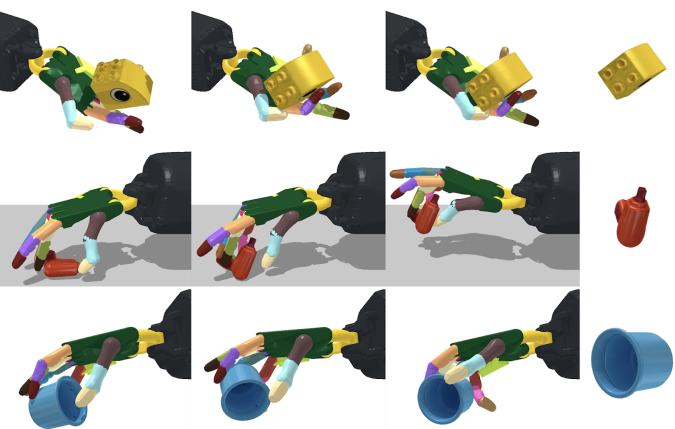
The research team found that a simple approach can solve complex problems. They used a model-free reinforcement learning algorithm (meaning the system must compute value functions based on interaction with the environment) with deep learning and a so-called "teacher-student" training method.
To make this work, a "teacher" network is trained on information about the object and robot that is easily available in simulation but not in the real world, such as fingertip positions or object velocity. To ensure that robots can work outside the simulation, the "teacher's" knowledge is turned into observations that can be obtained in the real world, such as depth images captured by cameras, the object's position, and the robot's joint positions.
They also used a "gravity curriculum" in which the robot first learns a skill in zero-gravity conditions, then slowly adapts the controller to normal gravity, which at this pace actually improves overall performance. Although it may seem counterintuitive, a single controller (known as the robot's brain) can reorient a large number of objects it has never seen before, and without knowing their shape.

“Initially, we thought that visual perception algorithms for determining shape while the robot manipulates an object would be the main challenge. On the contrary, our results show that it is possible to learn reliable control strategies that do not depend on shape. This suggests that visual perception may be a much less important tool for manipulation than we are used to thinking, and that sufficiently simpler perception processing strategies may be enough”
Many small round objects (apples, tennis balls, marbles) had an almost 100% chance of success when reoriented by the hand up and down. Not surprisingly, for more complex objects such as a spoon, screwdriver, or scissors, the success rate was only 30%. The researchers want to bring the system to market, since in the future success rates will not depend on the object's shape. The team notes that training the model on object shapes could improve performance.
Tao Chen co-authored the study with MIT CSAIL PhD student Jie Xu and MIT professor Pulkit Agrawal. The research is funded by the Toyota Research Institute, an Amazon Research Award, and the DARPA Machine Common Sense program. It will be presented at the Conference on Robot Learning (CoRL) in 2021.


