
Bipedal flying robot LEO can ride a skateboard and walk a slackline
A recently developed bipedal robot can smoothly switch between walking and flying, and it is this combination of two skills that makes this futuristic device remarkable. The robot is called LEONARDO, or LEO for short, an acronym for LEgs ONboARD drone, which describes the bot well but not completely.
The engineers at the California Institute of Technology who created LEO did not simply attach a pair of robotic legs to an aerial drone. They had to design the bot to both walk and fly, and develop specialized software to integrate its various components.
LEO is still a prototype, a kind of proof of concept that shows whether a bipedal flying robot can carry out tasks that would otherwise be difficult or impossible for ground robots or aerial drones. In the future, a full-scale version could be entrusted with complex or dangerous work, such as inspecting and repairing damaged infrastructure, installing new equipment in hard-to-reach places, or assisting after natural disasters and industrial accidents.
Ultimately, a robot like LEO could even transport fragile equipment to the surface of a celestial body such as Mars or a moon of Saturn. It is worrying that an agile bipedal flying bot could also be used in the defense sector or during military operations.
LEO's science-fiction traits are no accident. The creators said they were inspired by the fictional flying humanoid robot Astro Boy and by jet suits like Iron Man's. However, the goal of the project was to study the intersection of walking and flying in terms of dynamics and control, and to "provide an unprecedented ability to walk and solve problems associated with hybrid locomotion." The Caltech team also hopes to create an adaptive chassis for vertical takeoff and landing (VTOL) over complex terrain.
Nature has used this trick for a long time, since birds, bats, insects and many other organisms can switch between two modes of movement. Robots, by contrast, tend to be specialized and able to move only one of these two ways. This has its pros and cons: ground robots are stable and can carry heavy loads, but they are unstable on rough terrain and cannot gain altitude.
At the same time, aerial drones are very mobile and can fly in a wide variety of environments, but they cannot stay airborne for long because of high energy consumption, and they handle manipulation tasks poorly. This is where the desire to build a device that can use the best of both worlds comes from.
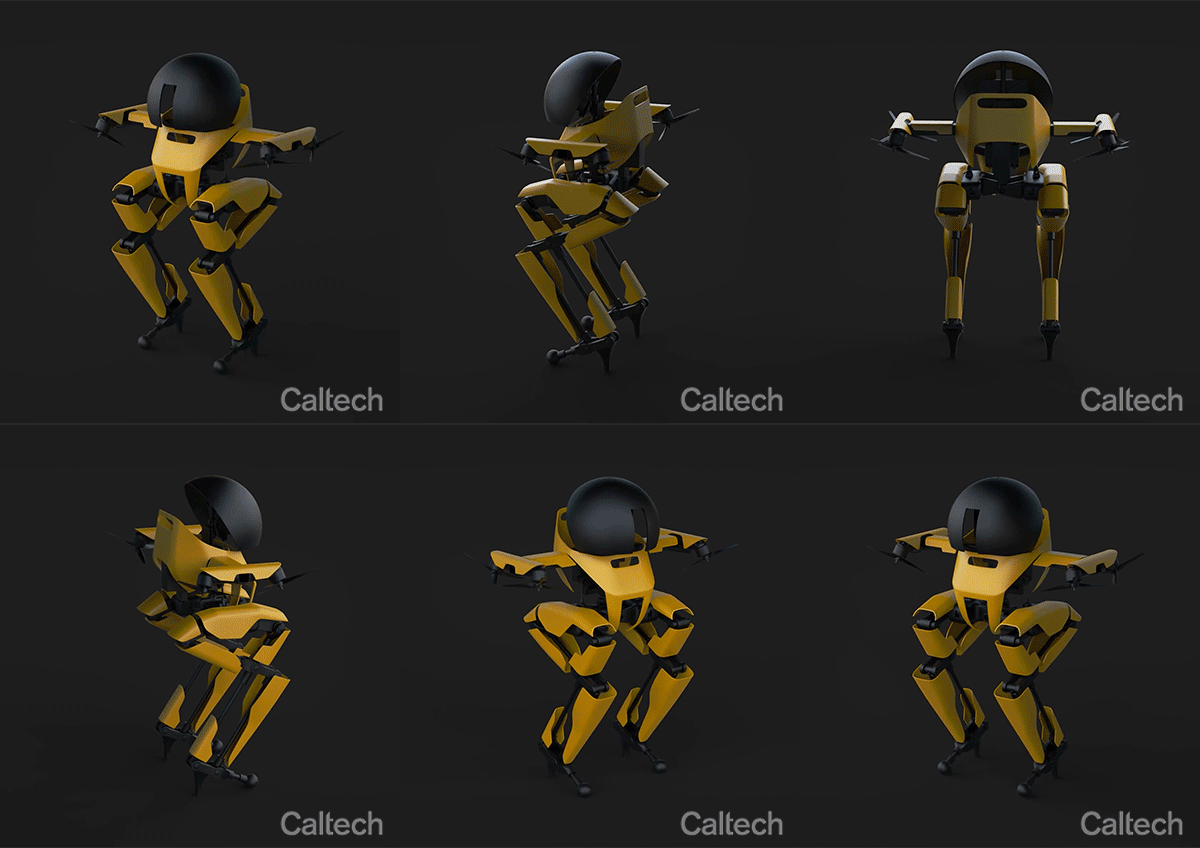
To achieve balance on the ground and maneuverability in the air, LEO had to be carefully designed. According to the researchers, this requires strong but lightweight components, as well as algorithms to synchronously control the four propellers and the joints of the bot's legs, ensuring that it walks or flies without losing balance. These two separate areas "are not usually intertwined in existing robotic systems, and we had to solve a broad set of engineering problems that have not been well studied in other existing robot systems."
LEO stands only 75 cm tall and weighs 2.58 kg. Like a bird, it uses its slender multi-jointed legs to push off the ground and assist takeoff. The bot's tilted electric motors, four rotor propellers, synchronize with these jumps. The robot walks as if on high heels, but they allow it to stand steadily. However, if conditions require, LEO's propellers can always engage to provide additional stability. Batteries, sensors and the necessary computing power are packed into the robot's torso, providing full autonomy and no bulky wires.
"We note that optimizing LEO's energy consumption was not a priority in this work. Instead, we focused on a wide range of capabilities," the researchers said. During tests, the device adapted and switched between fast walking and flying to avoid complex obstacles and perform difficult tasks requiring balance, including riding a skateboard and walking a rope.

LEO's design enabled "dynamic bipedal walking with complex ground interaction while retaining the flight characteristics of a multirotor vehicle." The team claims that LEO is the first bipedal robot to perform slacklining (walking on a tightrope), although it does so with the help of its propellers.
Thanks to the combined ability to walk and fly, the engineers hope to carry out a wide range of robotic tasks, such as inspecting high-voltage power lines and monitoring tall bridges. These bots could check aging infrastructure, work in disaster scenarios and even explore distant worlds.
“The propellers are tilted to stabilize LEO's movement more effectively, but this choice reduces their efficiency during flight. To minimize the weight that must be lifted, the legs must be thin and have limited mobility. LEO needs continuous propeller support while walking, which makes it more energy-intensive than a fully ground-based robot. The extent of these trade-offs, and therefore how close this multimodal robot is to a fully ground or aerial robot, depends on design choices. Minimizing these trade-offs remains a difficult challenge”
Mintchev was not involved in the new study, but advised the team to keep drawing inspiration from nature. Of course, there is room for improvement, but LEO is the first robot of a completely new generation.


