
By the end of 2021, Chinese hotel robots will take over 3,500 jobs
In China, where labor shortages and rising wages are becoming increasingly serious problems, robots are replacing routine, low-value-added, and sometimes dangerous human work. Hotels are no exception to this trend. As robotics continues to improve, service robots in hotels are attracting entrepreneurs and venture capitalists.
Founded in 2019, Shanghai Jingwu Intelligent Technology produces robots primarily for hotels. The startup's management, research and development team once worked in robotics at one of the companies and has 17 years of experience in the field.
Advantages of the Chinese company
Shanghai Jingwu Intelligent Technology has a number of advantages. First, the development team was able to design and manufacture the robot's core components based on years of research. They hold the intellectual property rights to these parts, which simplifies system integration and expansion of operations. They have also created a cloud platform and an internal management team to support the robotics industry ecosystem.
Second, the company has a large number of key control algorithms. In particular, the algorithm that calculates the route for robots making deliveries has an accuracy of 99.8%. In addition, the cloud platform can connect several types of robots and various equipment in the hotel.
Third, Shanghai Jingwu Intelligent Technology's robots are deployed on a modular principle to offer various services. This allows new functions to be constantly updated and developed.
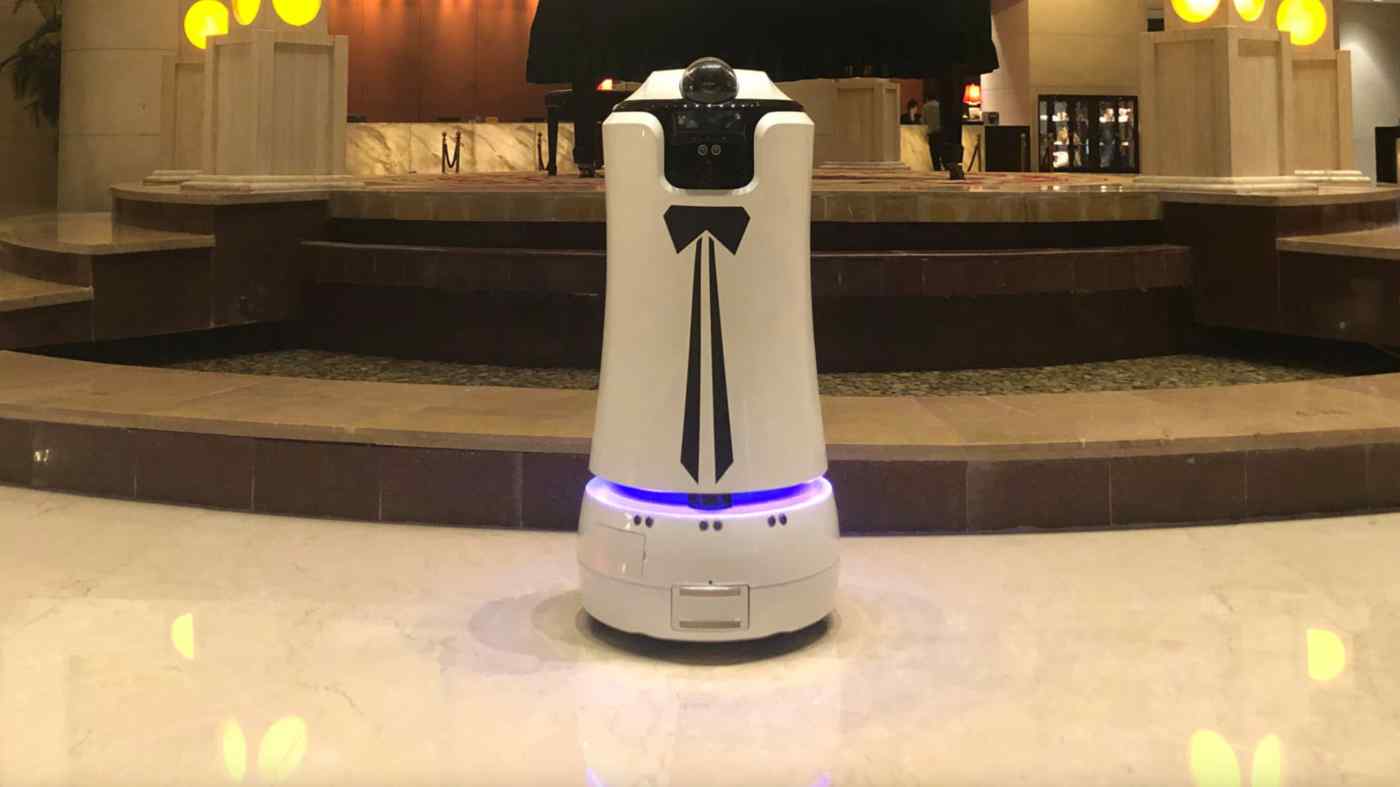
What delivery robots in hotels are used for
The company focuses primarily on delivery robots in hotels. They deliver food, mail and amenities ordered by hotel guests through the delivery service. The robots are also connected to in-room luggage storage, telephones, smart speakers and other equipment. Additional customizable modules can be installed, including security, privacy protection and body temperature scanning. The robots can complete 70-80 deliveries per day.
Data from a trial installation of Shanghai Jingwu Intelligent Technology robots carried out by Home Inn Selected, a major Chinese hotel chain, showed that the workload of one robot is equivalent to one hotel employee and one security guard, which reduces labor costs by approximately $1,400 per month. Adding a product sales function will increase labor cost savings by another $230 per month.
"Our main source of revenue is sending robots to large hotels and annual value-added service income. We have already established strategic cooperation relationships with large hotel chains such as Home Inn, Jinjiang Hotel and Dossen, and have deployed our products in almost 1,000 hotels," said Guo Zhen, founder of Jingwu Intelligent Technology.

Plans for the future
The company plans to increase the number of locations where its robots operate to 3,500 by the end of 2021, and to increase its annual revenue to more than $15.5 million.
Regarding the plans of Shanghai Jingwu Intelligent Technology, Zhen said: "Guided by the philosophy of cutting costs and improving efficiency, we want to enter the property management, food and beverage, and healthcare sectors to expand our market share."
The company believes that the key to competition in the hotel robot market is development and sales. The development team is working on optimizing and upgrading its delivery robots. Shanghai Jingwu Intelligent Technology plans to release another hotel robot by the end of 2021.
The company's sales department is made up of hotel industry professionals, which gives Shanghai Jingwu Intelligent Technology an advantage in this market. In the first half of 2021 alone, the company's unit sales equaled the sales of well-known robot manufacturers over five years.

Global service robot market
According to data published by the International Federation of Robotics (IFR), China's service robot market reached $2.2 billion in 2019, accounting for 25% of the global market. According to estimates by the China Electronics Institute, this share will reach 30% in the future.
The IFR report "World Robotics 2020 Industrial Robots" states that by 2023 the global service robot market will reach $27.7 billion, with a compound annual growth rate of 26%. Competition in the Chinese market is expected to intensify further, and its growth is forecast to reach $8 billion by 2023.
Robots in the hotel industry have become a popular technology trend, as automation and self-service ideas play an increasingly important role in customer service. Using robots can lead to higher speed, profitability and even accuracy.
For example, chatbots allow a hotel or travel company to provide round-the-clock support via online chat or instant messaging services, even when staff are unavailable, ensuring extremely fast response times. At the same time, a robot used during check-in can speed up the entire process by reducing queues.


