
MIT is developing a dynamic acrobatic humanoid robot
For a long time, a two-legged robot that could walk on a flat surface without falling, and even occasionally climb stairs, already seemed like an achievement. That time has now, one way or another, come to an end.
Thanks to the talented staff of companies such as Agility Robotics and Boston Dynamics, the world expects that two-legged robots will match or exceed real human performance in at least a small number of dynamic tasks. The next step, apparently, will be finding ways to surpass the limits of human ability. As it turns out, this involves acrobatics.
IHMC is developing its own child-sized acrobatic humanoid named Nadia, while researchers at the Massachusetts Institute of Technology (MIT) are working on their own acrobatic robot.
MIT's Biomimetic Robotics Lab has already built many legged robots, including Cheetah and HERMES. Recently, researchers have worked extensively with their daring Mini Cheetahs (developed with financial support from Naver Labs), which are designed for certain dynamic tasks, including some light acrobatics for quadrupeds.

In a paper published on arXiv, Matthew Chignoli, Donghyun Kim, Elijah Stanger-Jones and Sangbae Kim describe a "new humanoid robot design, a kino-dynamic motion planner, and a landing controller as part of a practical system project for highly dynamic motion control of a humanoid robot." They describe not just the robot, but the entire software infrastructure needed to make the robot do anything.
Matthew Chignoli said that MIT Humanoid looks like a vertical version of Mini Cheetah, but appearances are deceiving. The robot's torso and arms are very similar to Mini Cheetah, but the leg design is completely new and includes upgraded actuators with higher power and better torque density.
The main goal of the leg design is to enable smooth yet dynamic "heel-to-toe" movements, like those in human walking and running, while keeping low inertia for smooth interaction with ground contacts. Dynamic ankle movements are rare in humanoid robots. MIT hopes to develop strong, low-inertia, and powerful legs that mimic the leg movements of humans.
"The design strategy matters because humanoid robotics is currently dominated by hydraulically actuated robots and series elastic actuator robots. By continuing to improve the performance of our proprioceptive actuator technology, we aim to demonstrate that our unique combination of high torque density, wide-bandwidth force control, and impact mitigation capability is optimal for highly dynamic locomotion of any legged robot, including humanoids," said Matthew Chignoli, MIT.
The video is a simulation, but one should not immediately assume that "anyone can make anything work in simulation." MIT is putting a lot of effort into accurately modeling everything possible. The researchers model detailed physical constraints the robot faces when performing dynamic movements, which allows the planner to account for these constraints and generate motions that closely match the simulation.
When it comes to the robot's physical capabilities, everything demonstrated in simulation must be feasible on the robot. The research team includes detailed models of the robot's actuators and battery in their simulations, which are not often included in dynamic robot simulations. However, a simulation is still a simulation. No matter how good the modeling is, the real task can be difficult, especially when performing highly dynamic movements.
"Despite our confidence in our simulator's ability to replicate our robot's physical capabilities with high accuracy, there are aspects that remain uncertain as we aim to deploy our acrobatic movements on hardware. The main challenge we see is state estimation. We relied on research related to state estimation for drones, which uses visual odometry. However, without a built robot to test these new estimation strategies, it is hard to judge the real-world transfer of the simulation," said Matthew Chignoli, MIT.
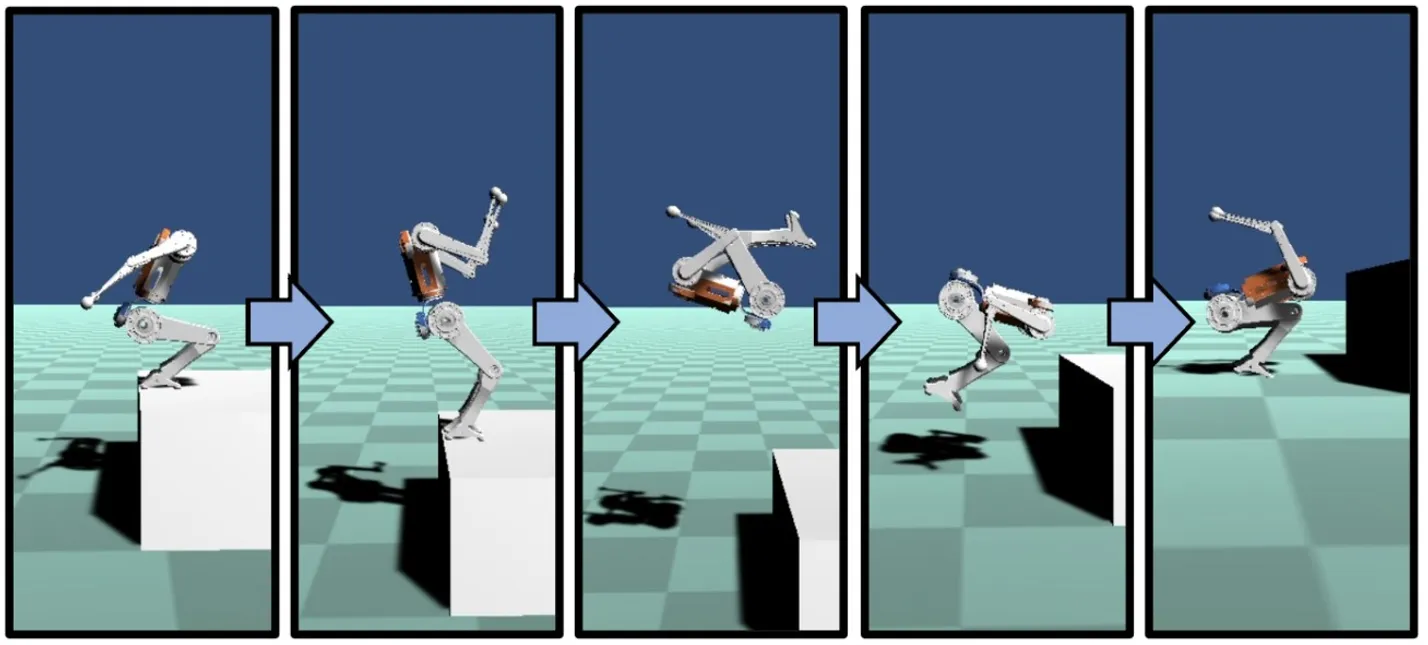
The design of MIT's humanoid is already complete, and they plan to build it for real over the summer. The ultimate goal is for the robot to be able to do parkour on difficult terrain. Parkour and acrobatics are certainly interesting, but the researchers state that the truly important contribution here is the framework, not the robot itself.
The acrobatic movements demonstrated on the humanoid are less about real acrobatics and more about what the ability to perform such tricks implies for both MIT's hardware and its control system. The movements matter from the robot's capability standpoint, since they prove (at least in simulation) that the dynamic feats of Boston Dynamics' ATLAS robot can be reproduced using a completely different actuation scheme.
Humanity is already thinking about how to develop the next generation of dynamic humanoid robots. The acrobatic movements demonstrate the ability to create realistic motion plans that push the boundaries of what MIT's robot can do.


